Launches updates
Iran Launches Intermediate-Range Missiles toward Diego Garcia, Marking First Combat Use


20 March 2026
On 20 March 2026, Iran reportedly launched two intermediate-range ballistic missiles (IRBMs) toward the joint U.S. and British base on Diego Garcia, a British Indian Ocean Territory located approximately 4,000 km from the Iranian coast.1 Although neither missile reached its target, this event marks the first confirmed combat use of intermediate-range ballistic missiles by Iran. The attempt was detected by radar and likely involved a two-stage missile according to Israel defense forces.. Experts have pointed to a probable use of a Iranian SLV, notably the Ghaem 100, which combines technologies that overlap with those of IRBMs and, is capable of carrying a significant payload over several thousand kilometers (3,000 to 4,000 km).2 Resorting to a new version of the Khorramshahr-4 is also a possibility.
At first glance, the Khorramshahr might have seemed an unlikely candidate for this strike, particularly for technical reasons: the Khorramshahr is a liquid-fueled ballistic missile with an official range of around 2,000 km, designed for regional strikes rather than very long-range attacks such as the one toward Diego Garcia. Derived from the North Korean Hwasong 10 / Musudan, the Khorramshahr would be unlikely to significantly exceed its esteemed range while retaining a military warhead. However, according to some visuals, the Khorramshahr-4 may be using two stages, and could therefore be a viable option.3
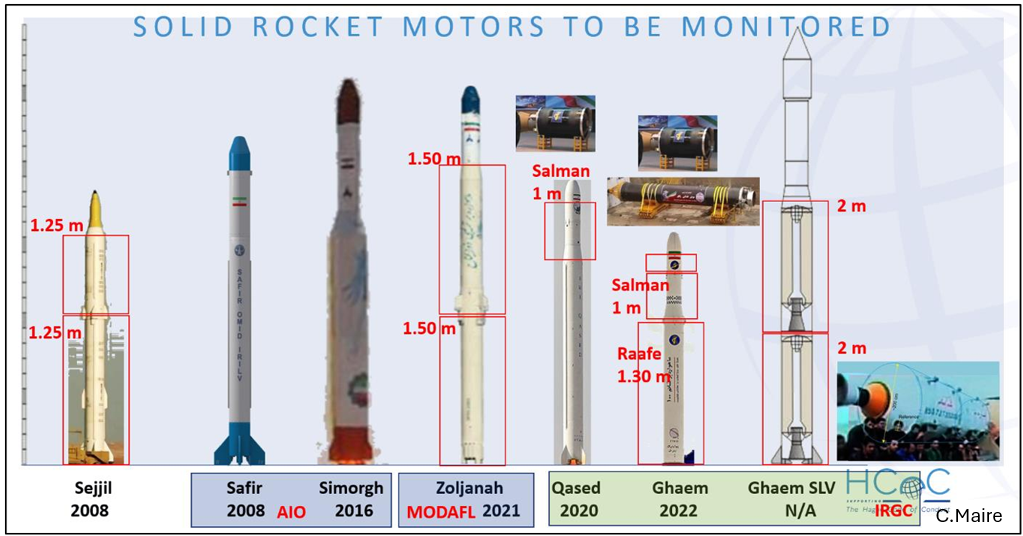
Another option would be the conversion of a space launcher into a strike system. As it decided to focus on medium-range ballistic systems, Iran chose to use its developed technologies for its budding space launch programmes.4
As a consequence, Iranian multi-stage space launch vehicles, although designed to place small payloads into orbit, use solid-fuel engines and structural configurations that could allow them to reach and exceed intermediate distances when adapted for strike missions.
The use of a solid-fuel, multi-stage vehicle like the Ghaem-100 or a similar derivative for a very long-range strike attempt could have had practical advantages: solid propellants are more stable in storage and can be readied quickly, unlike liquid fuels, which require lengthy and sensitive preparations. A three-stage solid-fuel launcher can produce steady thrust and potentially reach 3,000 to 4,000 km. By comparison, other SLVs such as the Simorgh or the Zuljanah also have multi-stage architectures, with different designs: the Simorgh is a two-stage liquid-fuelled vehicle, and the Zuljanah combines solid and liquid stages. The Simorgh is too large and cumbersome, while the Safir is too short-ranged for Diego Garcia. The Zuljanah requires a fixed gantry to launch, making it less suitable. The Qased could represent another option, notably due to its capability to be launched from a transportable platform (transporter-erector launcher).5 However, in open-source references, among the SLVs, the Ghaem-100 is most frequently cited as a strong candidate for a use as a weapon. Given that the first-stage thrust of the Ghaem 100’s Raafe motor is about 68 tons, more than double the Qased’s 27 tons from its liquid-fuelled first stage, it can place roughly twice the payload (about 80 kg) despite having a similar total mass.6
One of the two missiles reportedly malfunctioned, while the other was intercepted by an SM-3. Given the high cost of SM-3 interceptors, the US Navy likely assessed that the missile was posing a significant threat. Therefore, even at a range of 4,000 km, the Iranians appear to have achieved a relatively precise strike.7
Beyond the technical analysis, this episode raises a broader issue of proliferation and strategic signalling: Iran has abandoned its self-imposed 2,000 km range limit and is beginning to demonstrate that its technical capabilities can reach much farther.
Time | 20/03/2026 |
Category | Intermediate- range Ballistic missile |
Launch Vehicule | ? |
Company | IRGC, IRAN |
Range | 4000 km |
Target | US-UK base, Diego Garcia |
1 Ankit Panda, “Missiles Over the Indian Ocean: 7 Observations on Iran’s March 20 Attempt on Diego Garcia“, 23 March 2026, https://panda.substack.com/p/missiles-over-the-indian-ocean-7
2 Iran Watch, “Table of Iran’s Missile Arsenal”, 26 January 2026, https://www.iranwatch.org/our-publications/weapon-program-background-report/table-irans-missile-arsenal
3 Global military, “Missile Kheibar/ Khorramshahr-4”, 2025, https://www.globalmilitary.net/fr/missiles/
4 Jeffrey Lewis, 21 March 2026, https://bsky.app/profile/armscontrolwonk.bsky.social/post/3mhlfgzts7k2p
5 Gunter Space Page, “Qased”, 21 July 2025, https://space.skyrocket.de/doc_lau/qased.htm
6 John Krzyzaniak, “How the Ghaem-100 Rocket Puts Iran’s Space Program on a New Trajectory”, 19 december 2022, https://www.iranwatch.org/our-publications/articles-reports/how-ghaem-100-rocket-puts-irans-space-program-new-trajectory
7 Subhadra Srivastava, “Iran targets US base 4,000 km away: How US Navy’s SM-3 interceptor works and why it matters”, 21 March 2026, https://www.wionews.com/photos/-iran-targets-us-base-4-000-km-away-how-us-navy-s-sm-3-interceptor-works-and-why-it-matters-1774082030907/1774082030909