
Launches updates

SLS

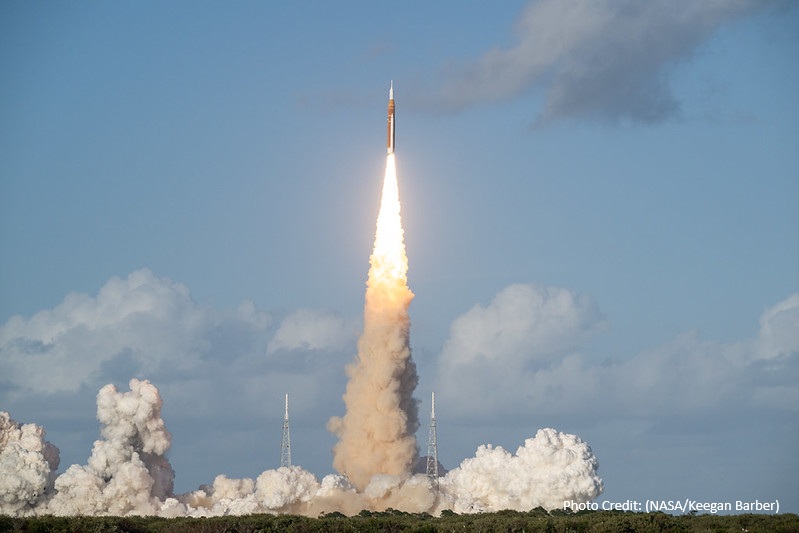
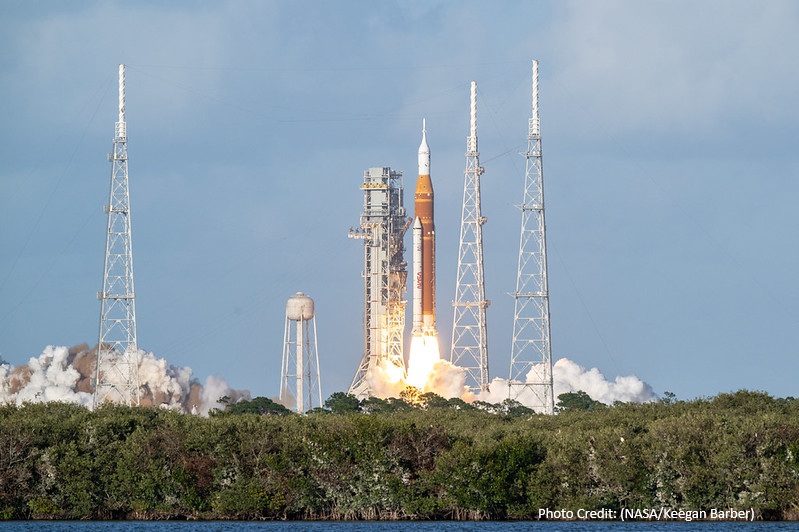
Successful launch for the Artemis II mission

descarga
Flag_of_the_United_States.svg

02/04/2026

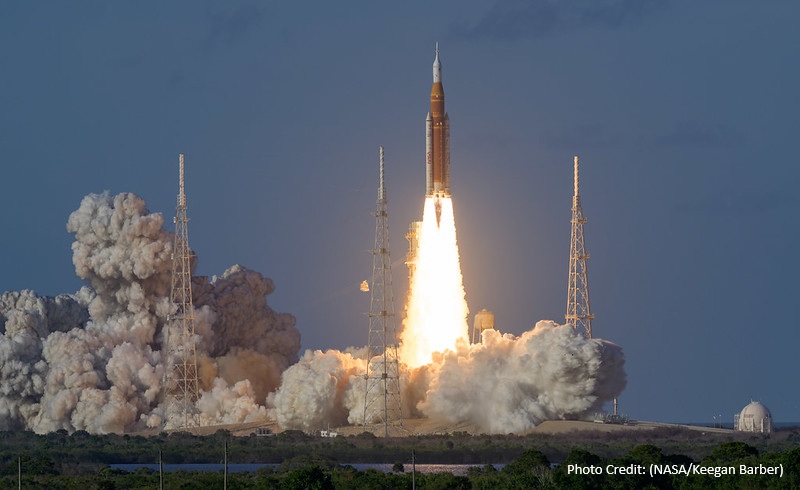
On 2 April 2026, at 00:24 UTC, NASA launched the Space Launch System (SLS) from the Kennedy Space Center as part of its Artemis II mission, marking the first crewed flight to lunar orbit since the Apollo missions. The mission aims to test the Orion spacecraft and the SLS rocket in deep space, perform a flyby of the Moon, and demonstrate proximity operations with the Interim Cryogenic Propulsion Stage (ICPS).1 Artemis II is part of a long-term strategy to return sustainably to the Moon and prepares for future crewed missions to Mars, while relying on international cooperation through the European Service Module developed by ESA.2

The SLS forms the technical core of this mission. The rocket combines four RS-25 liquid-fueled engines with two five-segment solid rocket boosters inherited from the Space Shuttle, producing a maximum thrust of 8,8 million pounds (= 39,144 kN). The boosters provide thrust for the initial two minutes, while the RS-25 engines propel the vehicle for eight minutes to reach Earth orbit. The SLS architecture includes several critical subsystems, such as propellant supply, pressurization, main propulsion, and pre-launch pneumatics, with industrial shared responsibilities: Boeing for the core stage and ICPS, L3Harris for the RS-25 engines, Northrop Grumman for the boosters, and Teledyne Brown Engineering for the launch vehicle adapter.

Despite its performance, the SLS faces significant economic and management challenges. The NASA Office of Inspector General report (2023) notes cost overruns of approximately $6 billion and over six years of delays on certain engine and booster contracts.3 These issues highlight the programme’s complexity and the rigor required to integrate all critical systems. Nevertheless, the SLS currently remains the only operational solution capable of sending astronauts directly around the Moon, providing a level of reliability that commercial launchers in development have not yet achieved.4

Time

02/04/2026 – 00:24 am

Launch Vehicule

SLC

Launch site

Kennedy Space Center, United States

Stages

2

Height

98 m

Launch Payload

LEO Orbit :    95 tons

Trans-lunar injection : 27 tons

1 NASA, SLS Reference Guide, Artemis II SLS Reference Guide Final Review, 2026, sls-5558-artemis-ii-sls-reference-guide-final-review-508-012026.pdf

2 ESA, Module de service européen pour Orion, https://www.esa.int/Space_in_Member_States/France/Module_de_service_europeen_fabrique_en_France

3 NASA Office of Inspector General, IG-23-015: SLS Program Audit Report, February 2023, https://oig.nasa.gov/wp-content/uploads/2024/02/IG-20-012.pdf

4 Reuters, NASA’s Moon mission tests aerospace old guard as SpaceX, Blue Origin hover, April 1, 2026, https://www.reuters.com/science/nasas-moon-mission-tests-aerospace-old-guard-spacex-blue-origin-hover-2026-04-01/

Research Papers

Harnessing Transparency Potential for Missile Non-Proliferation

Information is key for non-proliferation efforts. But the times when information was the exclusive purview of governments are over. Affordable, commercial and open-source monitoring capabilities empower states and societies alike, while challenging the ability of governments to preserve secrecy. Technological democratisation means that information is practically becoming a public good. And it allows for unprecedented transparency.

Read More »
Other publications

The Hague Code of Conduct Against Ballistic Missile Proliferation: “Lessons Learned” for the European Union Draft Code of Conduct for Outer Space Activities

Concerns about the harm caused upon orbiting space objects – whether intentional or accidental – have increased in recent years, as well as the emerging awareness that the security and safety of national satellites – of vital importance for modern societies but at the same time so vulnerable – relies on a collective effort. In December 2008 the EU responded to these concerns by adopting a Draft Code of Conduct (EU Draft CoC) for outer space activities.

Read More »