Launches updates
SARMAT:
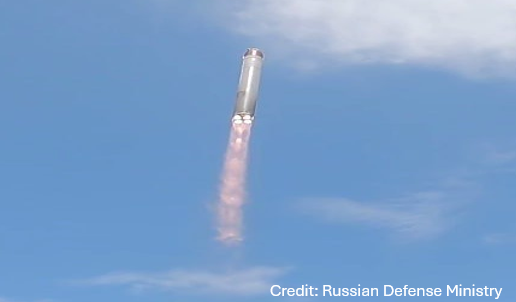
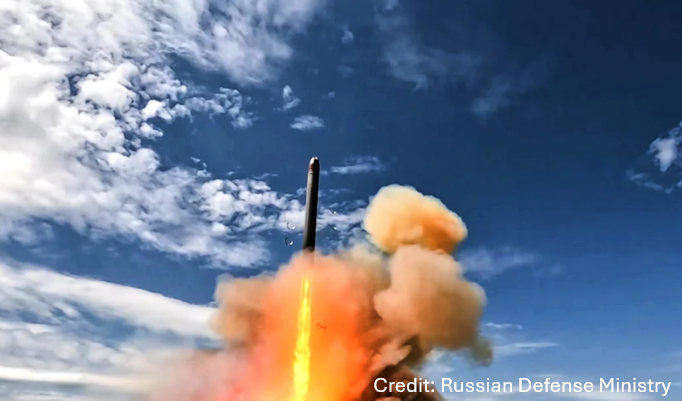
Russia Conducted New Sarmat ICBM Test


12/05/2026
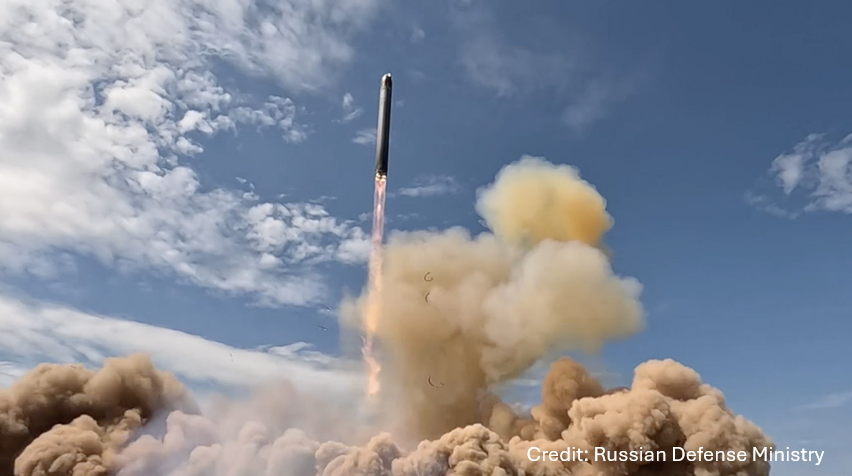
Russia has conducted a test launch of the heavy intercontinental ballistic missile RS-28 Sarmat, confirmed as successful by the authorities after a series of earlier tests marked by failures. Key test milestones include a first ejection test in December 2017, a second in March 2018, and the first full-range flight test conducted on 20 April 2022 towards the Kura test range. Additional tests in 2023 have been marked as failures, in particular on 28 November 2025, which destroyed the launch pad.1
According to official Kremlin communications, the Strategic Missile Forces launched this new liquid-fueled ICBM as part of the ongoing validation programme. This launch comes after a likely postponement from a few weeks aimed at increasing reliability, following earlier test failures occurring very early in flight that had raised questions about the system’s maturity. 2
Showcase of Russian nuclear modernisation programmes,3 the Sarmat is intended to replace the RS-20 Voevoda ICBMs, which were developed in Ukraine during the Soviet era. Although post-Soviet agreements initially allowed for cooperation between Kyiv and Moscow to maintain these systems, the deterioration of relations and the 2014 crisis in Crimea effectively ended this cooperation, making the sustainment of the Voevoda fleet significantly more complex. The Sarmat development programme was formally initiated in 2011, when the Russian Ministry of Defence awarded a development contract to the Makeyev Rocket Centre, in cooperation with a wide network of Russian industrial partners, following an extended preparatory phase that included early conceptual work in the late 2000s and formal R&D authorization in 2010, before progressing through prototype design and industrial preparation stages ahead of flight testing. 4
Rather than representing a strategic rupture, the Sarmat primarily enables Russia to preserve a fleet of heavy ICBMs capable of striking hardened targets such as US missile silo fields, while also ensuring a high level of retaliatory destruction in the event of a partial degradation of its own nuclear forces during a surprise attack. The system introduces improvements, including a shorter boost-phase designed to complicate interception by future missile defense systems, such as concepts associated with the US “Golden Dome” initiative. Contrary to what Kremlin propagandists regularly claim, the Sarmat is not primarily intended for use against Europe, but rather for strategic deterrence against the United States. 5
According to technical assessments, the current test campaign appears to include multiple mission profiles. At least one short-range test (~ 2000 km) and one long-range test (>15000 km) were reportedly planned, alongside a possible configuration involving the Avangard warhead. An additional NOTAM released by Russia is also interpreted as relating to an injection phase or early fairing separation, suggesting that the program is designed to validate different phases of flight rather than a single ballistic profile. The system introduces extended capabilities including suborbital trajectories, potentially extending its range beyond 35 000 km while improving accuracy. 6 The reference to a “suborbital” trajectory and this increased operational range announced by V. Putin in May 2026 has led some analysts to believe that a FOBS configuration could be envisaged.7 Its deployment has been announced by the Russian authorities for later in the year in Uzhur (62nd Missile Division of the 33rd Guards Missile Army).8
From a strategic perspective, analysts broadly converge on an interpretation of capability maintenance rather than a transformation of nuclear deterrence. The Sarmat replaces the ageing Voevoda system after long delays and roughly 15 years of development, during which Russia had limited alternatives to preserve its heavy ICBM force. As a result, even a system still undergoing maturation allows Russia to maintain a large-scale strike capability against hardened targets, particularly in the United States, without fundamentally altering the global strategic balance. 9
Time | 12/05/2026 |
Category | ICBM |
Launch Vehicule | RS-28 SARMAT |
Company | Strategic Missile Forces |
Range | Max: 35000km |
Trajectory | Ballistic and Suborbital trajectory |
Authors: Candice Corgeron and Etienne Marcuz
1 Christian Maire, Etienne Marcuz, FRS, Analyse et conséquences possibles de l’échec en vol d’un ICBM russe le 28 novembre 2025, 12 december 2025, https://www.frstrategie.org/publications/notes/analyse-consequences-possibles-echec-vol-un-icbm-russe-28-novembre-2025-2025
2 President of Russia, Statement by the President on the successful test launch of Sarmat missile, 12 May 2026, http://en.kremlin.ru/events/president/news/79724
3 Emmanuelle Maitre, Le Sarmat : vitrine du renouvellement des forces nucléaires russes, Bulletin n°53, Observatoire de la Dissuasion, FRS, 1er avril 2018, https://www.frstrategie.org/programmes/observatoire-de-la-dissuasion/sarmat-vitrine-renouvellement-forces-nucleaires-russes-2018
4 Christian Maire, Etienne Marcuz, FRS, Analyse et conséquences possibles de l’échec en vol d’un ICBM russe le 28 novembre 2025, 12 december 2025, https://www.frstrategie.org/publications/notes/analyse-consequences-possibles-echec-vol-un-icbm-russe-28-novembre-2025-2025
5 Etienne Marcuz, Tir d’un ICBM SARMAT par la Russie, 12 May 2026, https://x.com/Etienne_Marcuz/status/2054240024497922545
6 Etienne Marcuz, 13 May 2026, https://x.com/Etienne_Marcuz/status/2054448535932702854
7 Dmitry Stefanovich, STRATDELA Special #19, Stradela Newsletter, 13 May 2026, https://1dkv.substack.com/p/stratdela-special-19
9 Dmitry Stefanovitch, Few thoughts on the latest Sarmat test launch, 13 May 2026, https://x.com/KomissarWhipla/status/2054428061370638731