Launches updates

H3-30 Completes Successful Inaugural Flight

descarga
hinomaru

12/06/2026

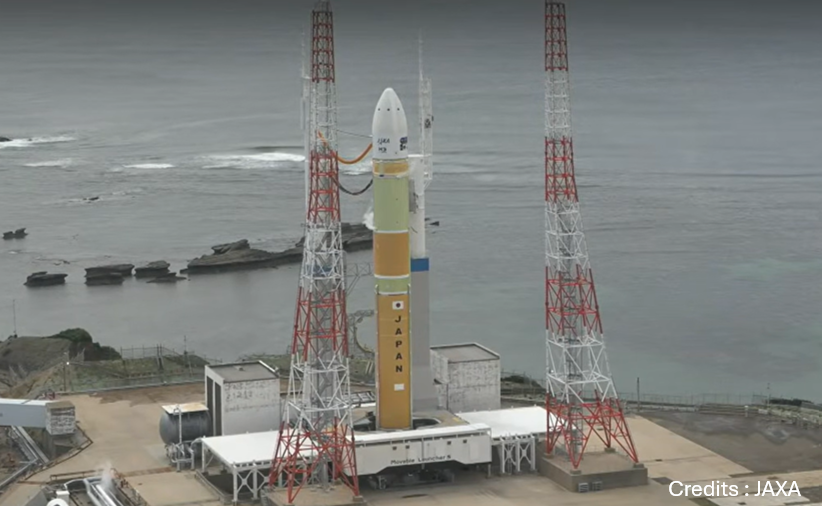
On June 12, 2026, Japan successfully launched the H3 No. 6 rocket from the Tanegashima Space Center. Liftoff occurred at 9:53 a.m. local time, and the vehicle reached its target orbit approximately sixteen minutes later. The mission marked both the resumption of H3 flights after nearly six months of interruption following the failure of the December 2025 mission, as well as the maiden flight of the new H3-30 configuration. According to JAXA, the launch proceeded as expected. 1

The mission also represented the inaugural flight of the H3-30 version, the lightest and most cost-efficient configuration in the H3 family. Unlike previous variants of the launcher, it carries no solid rocket boosters and relies only on three LE-9 liquid-fueled engines on the first stage. Developed by JAXA and Mitsubishi Heavy Industries (MHI), the H3 rocket is intended to succeed the H-IIA and provide Japan with a more flexible and internationally competitive launch system. 2

This flight was particularly anticipated following the failure of the H3 F8 mission in December 2025. The investigation conducted by JAXA identified a manufacturing defect in the payload adapter, which led to premature shutdown of the second-stage engine. After this incident, the H3 program was grounded for nearly six months in order to implement corrective measures and conduct additional inspections. The success of the H3-30 flight therefore represents a step in returning the launch system to operational reliability. 3

According to the JAXA, compared with earlier versions of the H3 family, the H3-30 was designed to reduce operational costs and strengthen Japan’s competitiveness in the international launch market. Its simplified architecture, without solid boosters, unlike the earlier H3-22S and H3-24L configurations, which used solid rocket boosters, makes it the most economical configuration of the rocket family. The H3-30 also represents a cost-efficient evolution of the H3 program and indirectly succeeds the H-IIA, which was retired in 2025 after twenty-five years of service. 4

Time

12/06/2026

Launch Vehicule

H3-30

Launch site

Tanegashima Space Center

Stages

2 stages

Company

JAXA Mitsubishi Heavy Industries

Launch Payload

LEO Orbit : 4000kg

1 Jessica Speed, TheJapanTimes, Japan successfully launches H3 rocket, 12 June 2026, https://www.japantimes.co.jp/news/2026/06/12/japan/science-health/japan-h3-rocket-launch/

2 JAXA, About the H3 Launch Vehicle, https://www.rocket.jaxa.jp/e/rocket/h3/index.html

3 Kyle Belmonte, TechTimes, Japan H3 Rocket Targets June 12: Maiden H3-30 Flight Validates Adapter Fix, Clears MMX Path, 12 June 2026, https://www.techtimes.com/articles/318099/20260609/japan-h3-rocket-targets-june-12-maiden-h3-30-flight-validates-adapter-fix-clears-mmx-path.htm

4 JAXA, About H-IIA Launch Vehicle, https://global.jaxa.jp/projects/rockets/h2a/

Research Papers

Limiting the proliferation of WMD means of delivery: a low-profile approach to bypass diplomatic deadlocks

Since the creation of the HCoC in 2002, the need for more collective commitment and action to fight the proliferation of ballistic missiles has certainly not decreased. The destabilizing nature of these weapons has not changed. Non-proliferation is just less about keeping the world stable and more about not adding a risk factor to an uncertain future. The HCoC was and remains a response to that need, but certainly not the end of the quest for improvement.
Read More »
Issue Briefs

The HCoC and Northeast Asian States

A majority of Northeast Asian states currently possess or seek to acquire ballistic missiles, producing a missile race and an increase in the number of tests as states are developing their capabilities further. Proliferation risks also remain high, and it is noteworthy that only South Korea and Japan have joined the MTCR.
Read More »
Other publications

Ballistic missile proliferation: what should be the role of a small state?

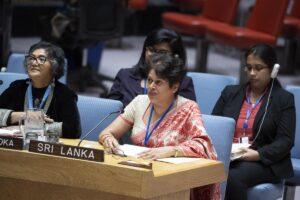
On 15 January 2019, the Institute of National Security Studies Sri Lanka (INSSSL) and the FRS held a South Asia Regional Seminar “Dealing with the missile threat in South Asia” with the support of the European Union. This explainer on ballistic missile proliferation explains a few key aspects of the Hague Code of Conduct against Ballistic Missile Proliferation (HCOC) in relation to small states with special reference to Sri Lanka.

Read More »