Launches updates
Ariane 64
A Successful Inaugural Flight on the Ariane 64 Heavy-Lift Configuration
12/02/2026
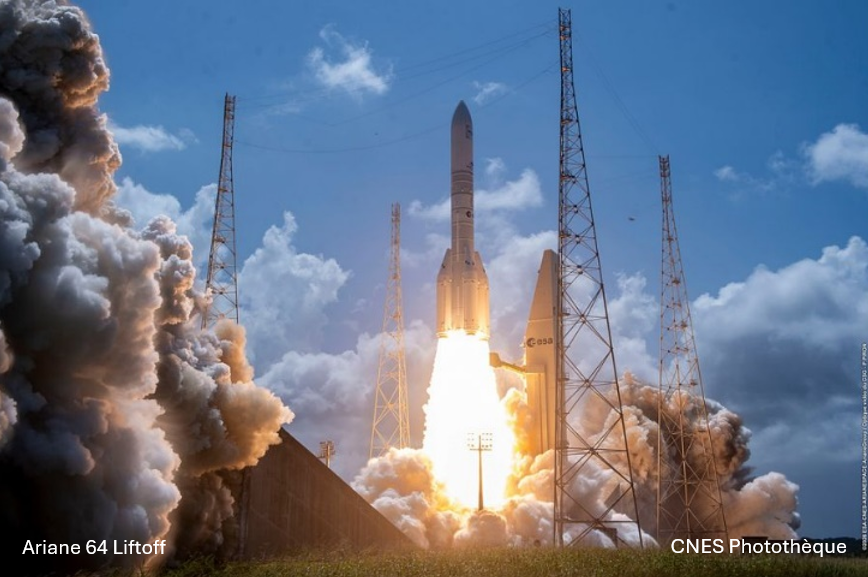
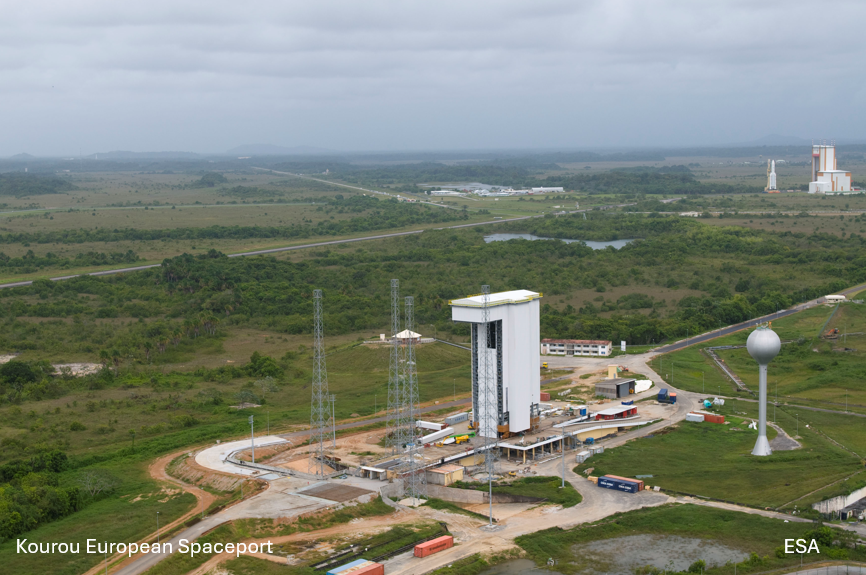
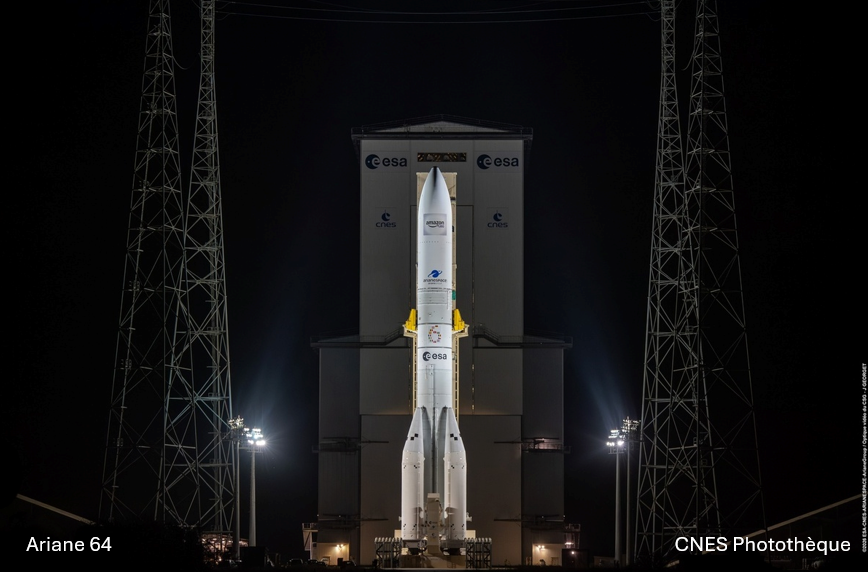
On 12 February 2026, at 13:45 local time, Arianespace successfully launched from Europe’s Spaceport in Kourou 32 Amazon Leo satellites using an Ariane 64 launcher.1 This mission, the first in a series of 18 launches operated by Arianespace to support the deployment of this constellation, marked the first mission carried out by the European launcher for this project. The satellites were injected into Low Earth Orbit (LEO) at an altitude of approximately 465 km during a mission that lasted 1 hour and 54 minutes from liftoff to final separation.2
Amazon Leo, formerly known as Project Kuiper, is a mega-constellation managed by Kuiper Systems LLC, an Amazon subsidiary, which plans to integrate 3,276 satellites to provide broadband internet access.3
For this first flight in the heavy configuration, Ariane 64 carried the heaviest payload ever transported by the European launcher4 demonstrating its capacity to inject 21.6 tons of payload into orbit.5
One of the major innovations of this flight is the APU (Auxiliary Propulsion Unit). Integrated into the upper stage, this unit provides a low but continuous thrust, essential for stabilizing the launcher’s orientation during the release of the 32 satellites thanks to its 3D-printed gas generator.6 The APU also plays a crucial role in the controlled deorbiting of the upper stage to limit space debris.7 This technical success allows Europe to now have two versions of the heavy launcher to meet its needs, with improvements already planned for 2026 to further increase carrying capacity.8
As a reminder, Ariane 64 relies on a deeply integrated European supply chain. Avio (Italy) produces the carbon booster casings, Arianegroup (France) manages the main engine, and Arianegroup (Germany) assembles the upper stage.9 The Vulcain 2.1 engine powers the core stage, while the upper stage features the Vinci engine.10 While the reignitable Vinci engine ensures precise placement, four P120C boosters consume 142,000 kg of solid propellant in just over two minutes to provide the initial thrust.11
From a strategic perspective, mission VA267 symbolises a reclamation of autonomous and competitive access to space for Europe.12
Time | 12/02/2026 – 1:45 pm |
Launch Vehicule | Ariane 64 |
Launch site | European Spaceport Kourou French Guiana |
Stages | 2 |
Height | 62cm (Long fairing) |
Launch Payload | LEO Orbit : 21,6 tons |
1 2 4 8 Arianegroup, ‘Arianespace lance avec succès 32 satellites Amazon Leo avec la première Ariane 64’, 12 February 2026, https://ariane.group/actualite/arianespace-lance-avec-succes-32-satellites-amazon-leo-avec-la-premiere-ariane-64/
3 RocketLaunch, ‘Amazon Leo (LE-01) Mission, 12 February 2026, https://rocketlaunch.org/mission-ariane-64-amazon-leo-le-01
5 6 7 10Jean Dichère, ‘Ariane 6 en mode XXL’, 10 February 2026, https://www.aquitaineonline.com/actu-news/france/12790-ariane6-amazon-leo-va267.html
9 ESA, ‘All engine for Ariane 6 complete qualification tests, 15 October 2020, https://www.esa.int/Enabling_Support/Space_Transportation/Ariane/All_engines_for_Ariane_6_complete_qualification_tests
11 Monica Pinna, ‘Europe Flagship Ariane 6 rocket launches with 32 satellites for Amazon Leo network, 12 February 2026, https://www.euronews.com/next/2026/02/12/europes-flagship-ariane-6-rocket-launches-with-32-satellites-for-amazon-leo-network
12 Revue économique de France, ‘Ariane 64 réussit son premier vol commercial et place 32 satellites Amazon Leo en orbite’, 13 February 2026, https://refrance.fr/ariane-64-reussit-son-premier-vol-commercial-et-place-32-satellites-amazon-leo-en-orbite/