Launches updates
China’s Full-Range SLBM Test in the Pacific


06/06/2026
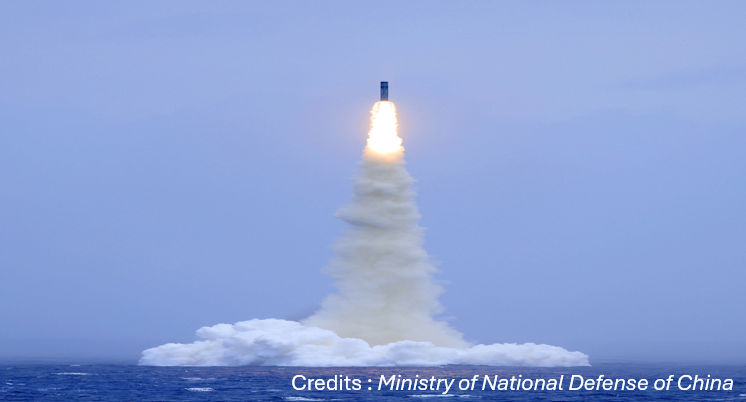
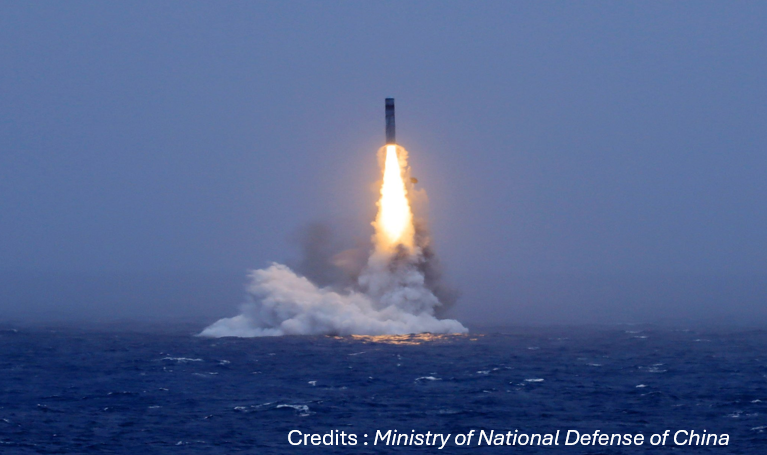
On 6 July 2026, China conducted the launch of a submarine-launched ballistic missile (SLBM) from a People’s Liberation Army Navy (PLAN) nuclear-powered ballistic missile submarine into a designated area of the Pacific Ocean. According to Chinese authorities, the missile carried a dummy warhead and was launched as part of the country’s annual military training program. Unlike previous Chinese SLBM tests, which typically use lofted trajectories allowing the reentry vehicle to fall within Chinese territory, this test followed a full-range trajectory, reportedly launched from the South China Sea off the coasts of Hong Kong and Macau with the payload reportedly impacting more than 7,200 km from the launch point, approximately 300 km east of Tonga, according to Taiwanese sources.1
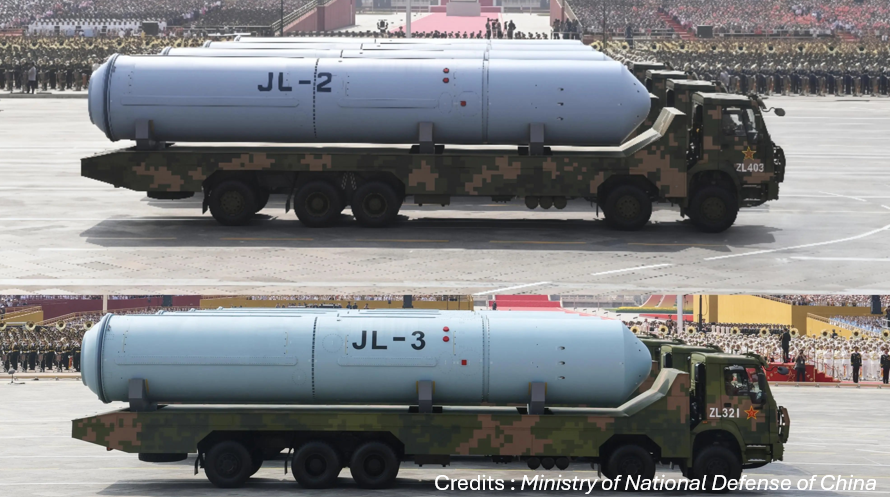
Beijing did not disclose the type of missile used. The PLAN currently operates two submarine-launched ballistic missiles (SLBMs), the JL-2 and the JL-3, and the missile involved in this test has not been officially identified. While some analysts consider the JL-3 a possible candidate based on the reported range and trajectory, the possibility that the test involved a JL-2 cannot be ruled out. Both missiles reportedly feature a three-stage, solid-propellant configuration. The JL-2 is assessed to carry a single nuclear warhead, while the JL-3 is believed to be capable of carrying approximately three to five warheads, likely through a MIRV (Multiple Independently Targetable Reentry Vehicle) capability. The JL-2 remains operational aboard China’s six Type 094 (Jin-class) SSBNs, which currently form the backbone of China’s sea-based nuclear deterrent.2
The JL-3 is believed to be China’s next-generation SLBM, although many of its characteristics remain unconfirmed. Open-source assessments describe it as a missile with an estimated range of approximately 10,000 km, significantly extending China’s strike reach compared with the JL-2, whose range is estimated at around 8,000-9,000 km. Its guidance system is thought to combine inertial navigation, astronomical guidance, and China’s BeiDou satellite navigation system. The missile is expected to equip future Type 096 SSBNs currently under development, although some assessments suggest that it may already have been integrated into existing Type 094 submarines.3
The extended range of the JL-3 allows China, in theory, to hold targets in the continental United States at risk while operating from waters closer to its own coastline, reducing the need for SSBNs to patrol deep into the Pacific. The full-range trajectory used in this test is also significant, as it places different thermal and mechanical stresses on the missile during reentry compared to standard lofted trajectories. Such tests can be observed by other powers to assess performance parameters, and open-source reports indicated that the U.S. Air Force deployed a Cobra Ball telemetry and tracking aircraft in the region during the launch.4
China notified several regional countries in advance and established temporary maritime and airspace restrictions around the test area. While Australia, Japan, and New Zealand confirmed they had received prior notification, they also expressed concern over the test. China described the launch as a routine training activity conducted safely and not directed against any specific country.
Time | 06/06/2026, 12:01pm |
Category | SLBM |
Launch Vehicule | Strategic SSBN |
Company | Chinese Navy (PLAN) |
Range | JL-2: 8000km JL-3: 10000km |
Type | Unconfirmed JL-2 or JL-3 |
1 Reuters, “China test fires missile into Pacific, alarming regional powers”, 6 July 2026, https://www.reuters.com/world/china/china-test-fires-missile-into-pacific-alarming-regional-powers-2026-07-06/
2 Times of India, “China’s JL missile family: The submarine-launched nukes designed to reach US”, 6 July 2026, https://timesofindia.indiatimes.com/defence/international/chinas-jl-missile-family-the-submarine-launched-nukes-designed-to-reach-the-us/articleshow/132215305.cms
3 Josh Butler, Dan Jervis-Bardy, The Guardian, “China tests long-range missile in South Pacific in move Australia condemns as ‘destabilising to region’”, 6 July 2026, https://www.theguardian.com/world/2026/jul/06/china-missile-test-south-pacific
4 Etienne Marcuz, “Tir de missile depuis un SNLE chinois”, 6 July 2026, https://x.com/Etienne_Marcuz/status/2074050194564420051