Launches updates
China’s Long March 10B Demonstrates First-Stage Recovery Capability


10/07/2026
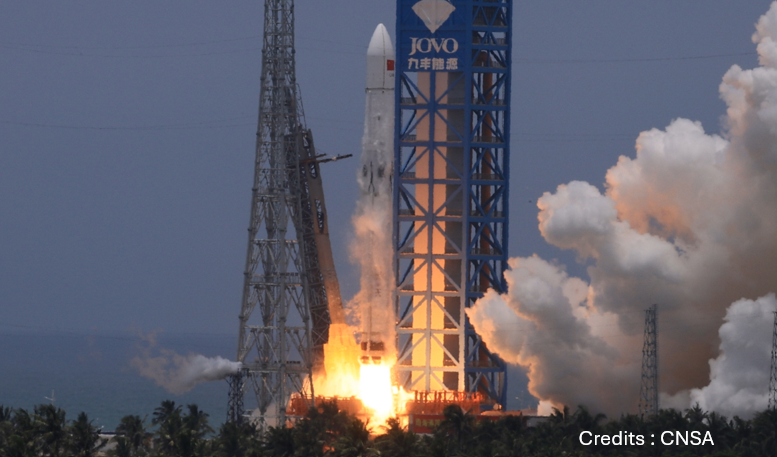
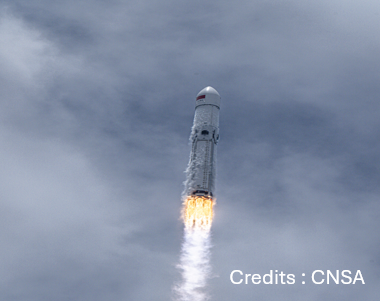
China conducted the maiden flight of the Long March 10B on 10 July 2026 from the Wenchang Space Launch Site in Hainan Province. The mission represented a major milestone for China’s reusable launch vehicle program, achieving the first controlled recovery of the first stage of a Chinese launch vehicle during an orbital mission.1
Developed under the responsibility of the China Academy of Launch Vehicle Technology (CALT), a subsidiary of CASC, the Long March 10B is a 5-metre-diameter, two-stage tandem launch vehicle. Its first stage is powered by seven YF-100K engines burning kerosene and liquid oxygen (LOX), while the second stage uses liquid methane and liquid oxygen propulsion. The launcher can deliver up to 16 tons to low Earth orbit and is mainly designed for cargo missions. The Long March 10 family is also considered a key element of China’s plans for future crewed lunar missions.2
The choice of kerosene and liquid oxygen for the first stage is linked to the requirements of the launch phase. This combination provides high thrust at liftoff while relying on a mature and well-established technology. Used for several decades in launch vehicles, kerosene benefits from extensive operational experience in engines and related systems. For the Long March 10 family, which is intended to support future crewed lunar missions, this technological maturity and reliability are key considerations.
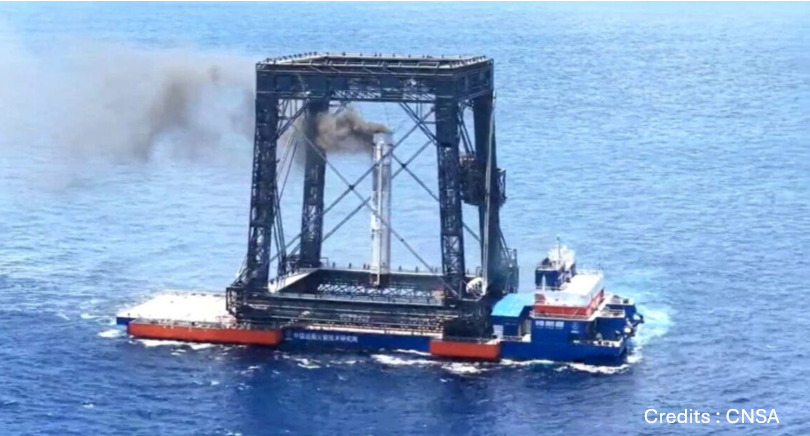
The main innovation of the Long March 10B lies in its first-stage recovery system. Unlike reusable launch vehicles such as SpaceX’s Falcon 9, which use deployable landing legs, the Long March 10B relies on an architecture based on landing hooks and a net structure installed on a sea-based recovery platform. Approximately six minutes after the separation of the booster and upper stage, the first stage returned to a floating platform, where it was captured by a net structure mounted on the recovery vessel. This architecture removes the need for landing legs and reduces the associated mass and volume, which can be redirected toward payload capacity.3
The achievement made China the second country to recover an orbital booster. It also highlights the growing competition within China’s reusable launch vehicle sector, where both state-owned and commercial actors are developing new systems. Recent examples include the Long March 12B, which conducted its maiden flight in June 2026 and was designed with future first-stage recovery capabilities, as well as LandSpace’s ZhuQue-3, which relies on a liquid methane and liquid oxygen propulsion architecture. These developments reflect China’s broader efforts to expand its reusable launch capabilities across different vehicle classes. 4
Time | 10/07/2026, 12:15pm Beijing Time |
Launch Vehicule | Long March 12B |
Launch site | Wenchang Space Launch Site, Hainan Province, China |
Stages | 2 stages |
Height | 63,6 m |
Launch Payload | LEO Orbit : 16 tons |
1 Xinhua,”La fusée chinoise Longue Marche-10B a effectué son premier vol, réussissant pour la première fois la récupération contrôlée de son premier étage”, 10 July 2026, http://www.french.xinhuanet.com/20260710/096270a4839b4f54b441b5db29fbb5a6/c.html
2 Victoria Bela, Ling Xin, “Long March-10B: China’s net-capture rocket joins space race with edge on SpaceX”, 10 July 2026, https://www.scmp.com/news/china/science/article/3360069/china-recovers-long-march-10b-reusable-rocket-maiden-launch
3 Fan Wei, Chen Qingqing, “China enters rocket recovery era as experts highlight breakthroughs of Long March 10B maiden flight”, 10 July 2026, https://www.globaltimes.cn/page/202607/1365624.shtml
4 FRS, “Long March 12B completes inaugural launch”, 1 June 2026, https://www.nonproliferation.eu/hcoc/lm12b-long-march-12b-completes-successful-inaugural-flight/