
Launches updates

SLS

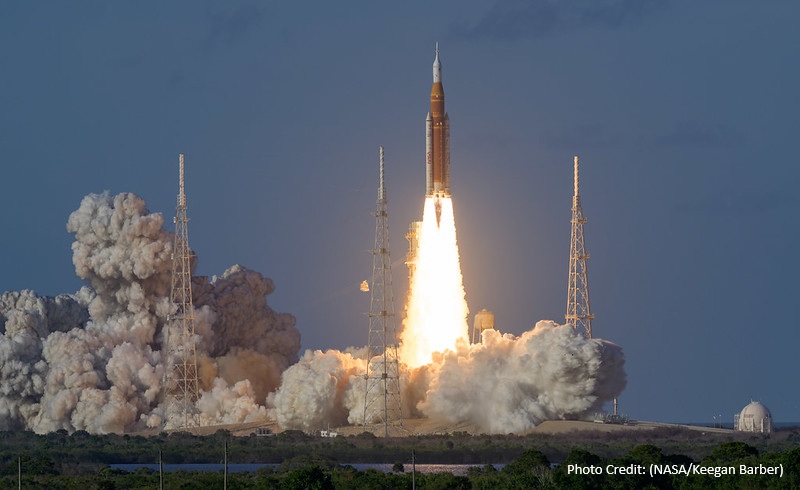
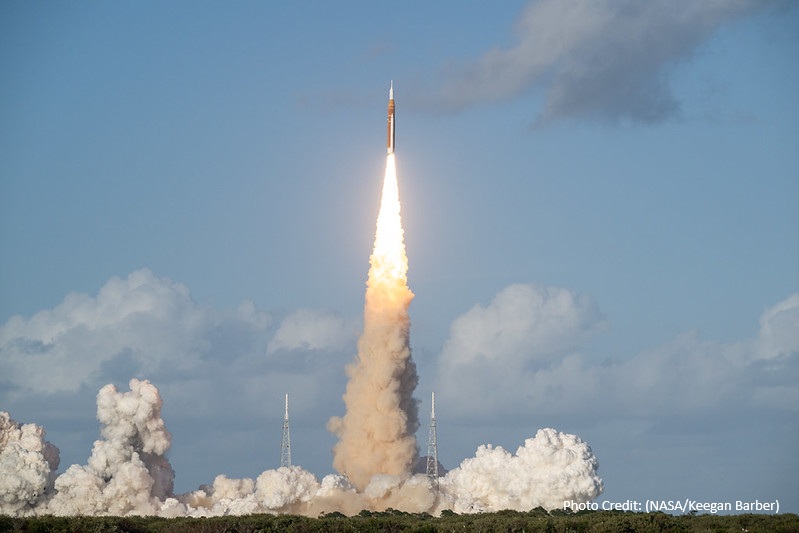
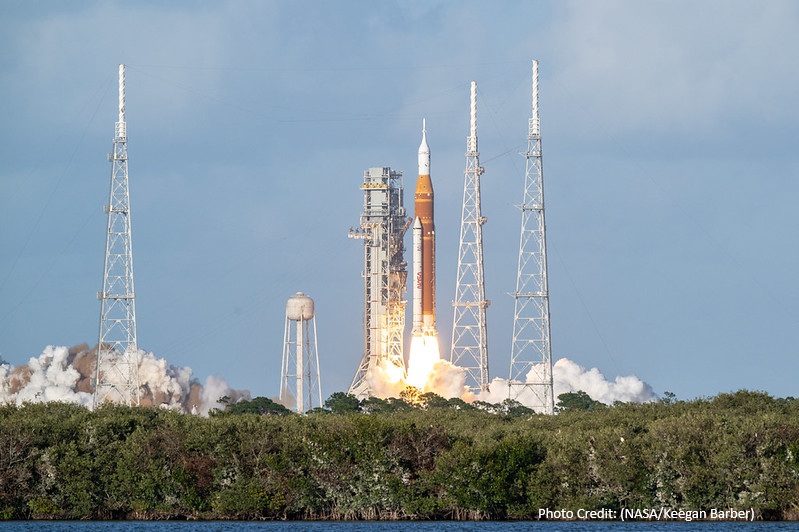
Successful launch for the Artemis II mission

descarga
Flag_of_the_United_States.svg

02/04/2026

On 2 April 2026, at 00:24 UTC, NASA launched the Space Launch System (SLS) from the Kennedy Space Center as part of its Artemis II mission, marking the first crewed flight to lunar orbit since the Apollo missions. The mission aims to test the Orion spacecraft and the SLS rocket in deep space, perform a flyby of the Moon, and demonstrate proximity operations with the Interim Cryogenic Propulsion Stage (ICPS).1 Artemis II is part of a long-term strategy to return sustainably to the Moon and prepares for future crewed missions to Mars, while relying on international cooperation through the European Service Module developed by ESA.2

The SLS forms the technical core of this mission. The rocket combines four RS-25 liquid-fueled engines with two five-segment solid rocket boosters inherited from the Space Shuttle, producing a maximum thrust of 8,8 million pounds (= 39,144 kN). The boosters provide thrust for the initial two minutes, while the RS-25 engines propel the vehicle for eight minutes to reach Earth orbit. The SLS architecture includes several critical subsystems, such as propellant supply, pressurization, main propulsion, and pre-launch pneumatics, with industrial shared responsibilities: Boeing for the core stage and ICPS, L3Harris for the RS-25 engines, Northrop Grumman for the boosters, and Teledyne Brown Engineering for the launch vehicle adapter.

Despite its performance, the SLS faces significant economic and management challenges. The NASA Office of Inspector General report (2023) notes cost overruns of approximately $6 billion and over six years of delays on certain engine and booster contracts.3 These issues highlight the programme’s complexity and the rigor required to integrate all critical systems. Nevertheless, the SLS currently remains the only operational solution capable of sending astronauts directly around the Moon, providing a level of reliability that commercial launchers in development have not yet achieved.4

Time

02/04/2026 – 00:24 am

Launch Vehicule

SLC

Launch site

Kennedy Space Center, United States

Stages

2

Height

98 m

Launch Payload

LEO Orbit :    95 tons

Trans-lunar injection : 27 tons

1 NASA, SLS Reference Guide, Artemis II SLS Reference Guide Final Review, 2026, sls-5558-artemis-ii-sls-reference-guide-final-review-508-012026.pdf

2 ESA, Module de service européen pour Orion, https://www.esa.int/Space_in_Member_States/France/Module_de_service_europeen_fabrique_en_France

3 NASA Office of Inspector General, IG-23-015: SLS Program Audit Report, February 2023, https://oig.nasa.gov/wp-content/uploads/2024/02/IG-20-012.pdf

4 Reuters, NASA’s Moon mission tests aerospace old guard as SpaceX, Blue Origin hover, April 1, 2026, https://www.reuters.com/science/nasas-moon-mission-tests-aerospace-old-guard-spacex-blue-origin-hover-2026-04-01/

Other publications

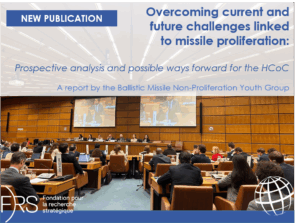
Overcoming current and future challenges linked to missile proliferation: Prospective analysis and possible ways forward for the HCoC

This report, written by the HCoC Youth Group, addresses four dimensions of missile proliferation: regional concerns, transfer to non-state actors, transformation of regulatory tools, and relations to space security. It studies in particular how these developments could impact the way the Hague Code of Conduct tackles missile proliferation and proposes ways forward.

Read More »
Issue Briefs

The Hague Code of Conduct in the Middle East

The HCoC holds special significance in the Middle East as the region is fraught with the development of ballistic arsenals, the use of missiles on the battlefield and the proliferation of such systems towards both states and non-state actors. Moreover, several ballistic missile programmes have been closely associated with WMD acquisition.

Read More »
Other publications

Ballistic missile proliferation: what should be the role of a small state?

On 15 January 2019, the Institute of National Security Studies Sri Lanka (INSSSL) and the FRS held a South Asia Regional Seminar “Dealing with the missile threat in South Asia” with the support of the European Union. This explainer on ballistic missile proliferation explains a few key aspects of the Hague Code of Conduct against Ballistic Missile Proliferation (HCOC) in relation to small states with special reference to Sri Lanka.

Read More »