Visit of Air Force Base Swartkop, South Africa
25 November 2025
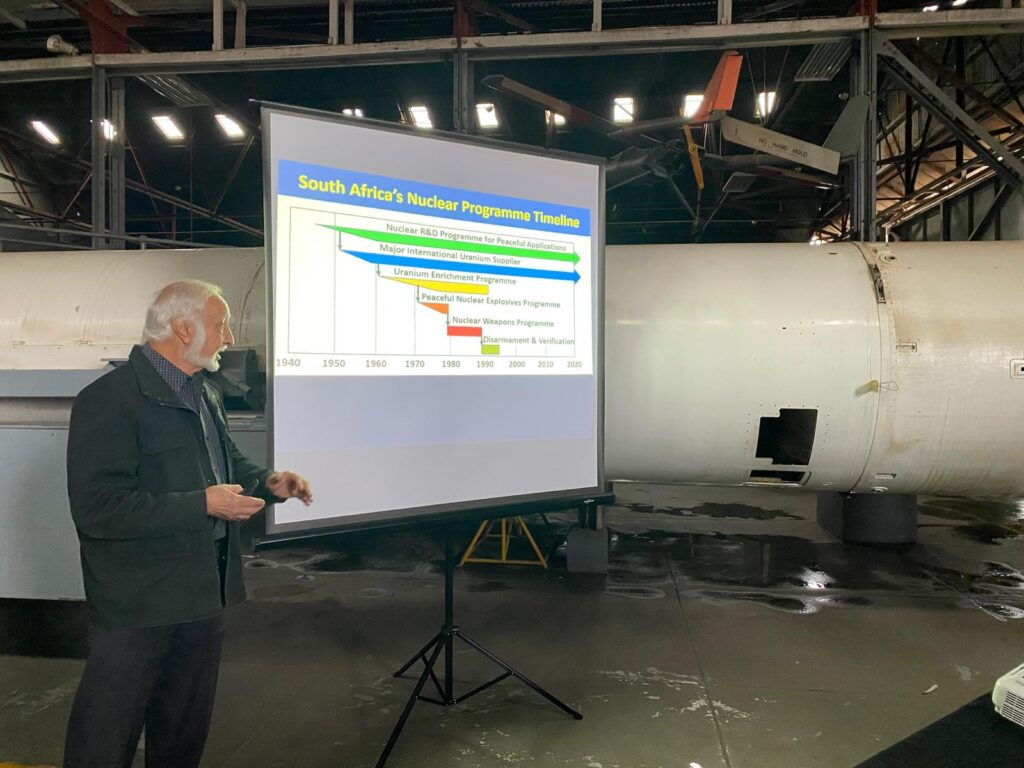
On 25 November 2025, as part of our regional seminar in South Africa, participants were received at the South African Air Force Museum, located at the Air Force Base Swartkop (Pretoria). They attended a presentation by Andre Buys on South Africa’s Ballistic Missile Programme and its dismantlement.
The visit, initiated and coordinated by Andre Buys, offered participants a unique insight into the history and dismantlement of South Africa’s ballistic missile and nuclear weapons programmes.
Andre Buys, member of the Nuclear and Missile Dual Use Committee (NMDUC) of the South African Council for the Non-Proliferation of Weapons of Mass Destruction, drew on his first-hand experience to guide participants through the technical and political milestones of the country’s ballistic missile programme and its dismantlement.
His presentation began with an overview of South Africa’s nuclear and missile history, from early nuclear research to its emergence as an international uranium supplier. Participants learned about the evolution of the uranium enrichment programme, the attemps to explode nuclear devices, the development of nuclear weapons, and ultimately, the process of disarmament and verification.
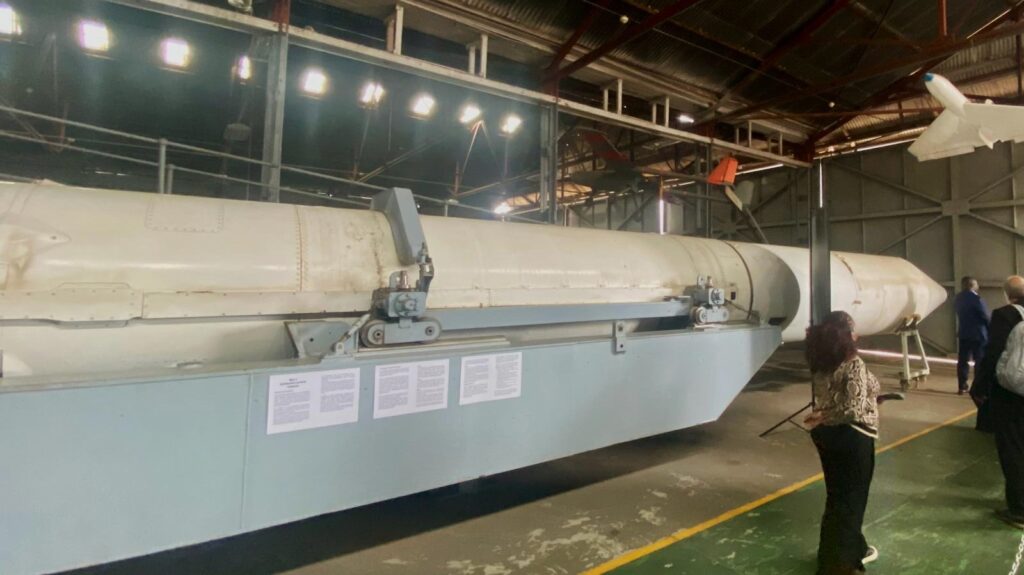
The session also included a look at South Africa’s nuclear arsenal and delivery systems as they stood in 1989, including images of the operational H2 glide bomb and the RSA series of ballistic missiles designed to carry nuclear warheads. Among the highlights of the visit was the opportunity to observe the RSA-3 (the only surviving missile from South Africa’s former arsenal) now preserved at the museum.
The RSA-3 was a three-stage, solid-fuel space launch vehicle derived from South Africa’s earlier RSA 1 and RSA 2 ballistic missiles. Developed in the 1980s as both a mobile-based deterrent and a satellite launcher, the RSA 3 was designed to place a satellite into low Earth orbit while also being technically capable of delivering a nuclear payload. Three reported test were launched from the Overberg test site in the late 1980s and 1990. Although work continued for some years after South Africa ended its nuclear weapons programme in 1989, the RSA-3 never conducted an operational orbital mission and the project was ultimately cancelled in 1994.
Finally, the presentation traced the timeline of South Africa’s termination of its nuclear and missile programmes, beginning in September 1989. This process culminated with South Africa’s accession to the Nuclear Non-Proliferation Treaty (NPT) in 1991, the dismantlement of hardware and installations between 1994 and 1995, and its adherence to the HCoC in 2002.
This visit provided participants with a rare opportunity to explore one of the most remarkable cases of nuclear and missile disarmament in history, combining technical insights with an historical perspective.