
Launches updates
North Korea proceeded to a missile test that raises questions
03/10/2026
On 3 October 2026, North Korea proceeded to a missile launch that raises a few questions. Initial assessments announced by the Japanese Ministry of Defence and confirmed by the South Korean government mention a missile launched from the East Coast of the DPRK, possibly the Wonsan region, that would have reached around 680 km to hit a target in the Sea of Japan/East Sea for a maximum altitude of 90 km. 1
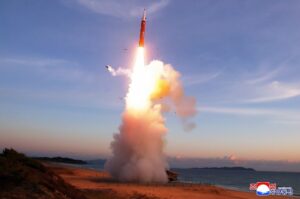
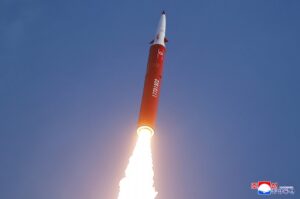
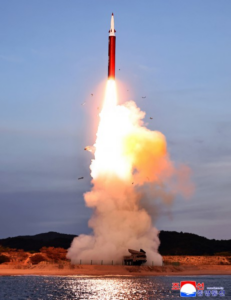
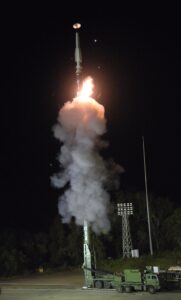
A couple hours later, however, a statement by Kim Yo-jong, Director of the General Affairs Department of the Worker’s Party of Korea and sister of Kim Jung-un, released from the North Korean press agency KCNA, noted that the missile used was an intermediate-range ballistic missile (IRBM) and that both Tokyo and Seoul were wrong in their assessments. The communiqué underlines weakness in both countries’ tracking abilities, and refers specifically to their inability to follow DPRK’s missile trajectories after the first “skip point”. According to Kim Yo-jong, the range of 700 km would correspond to the trajectory before a skipping manoeuvre. She refers to state-of the art technologies that would include AI and allow the weapon to change flight orbit at low altitude and therefore avoid interception. 2 The following day, the North Korean authorities went further and announced a range of 1,000 km covered by the missiles, and specified the impact location at 43°36′ 28.04″ and 138°00′ 47.02″ (a few miles within Japanese Exclusive Economic Zone). The communiqué insists on the operational nature of the drill. Pictures were also released, showing that Kim Jung-un and his family attended the launched. The missile displayed on the pictures cannot be associated to any known system from the North Korean arsenal. It does not have any control surface on the main booster but has four wings on the re-entry vehicle. It probably has two stages although the design of the interstage makes it difficult to ensure. This could make the injection of the warhead easier. 3
The use of skipping manoeuvres has already been identified as a common practice by Pyongyang, and leads to ambiguity on the range of its systems. Thus, the KN-23, a single-stage non-separable short-range missile, is generally recognised to have a range of around 450 km. But by using a depressed trajectory and skipping manoeuvres, it has been estimated to extend its range by 20% to reach almost 700 km. 4 This technological choice seems to have been made to complexify the task of US and South Korean defensive mission.
It should be noted however that from the available picture, the warhead mounted on this new missile might not be a classic choice for such a trajectory. According to the image published, the warhead would be a conical manoeuvrable warhead (MaRV), which presents similarities with the one mounted on the DF-15. The official narrative of Pyongyang should therefore be considered prudently regarding the missile’s characteristics, until more information becomes available.
Time | 03/10/2026 |
Category | IRBM |
Launch Vehicule | unidentified |
Country | DPRK |
Range | 700-1000 km ? |
Origin | DPRK |
1 北朝鮮のミサイル等関連情報, Ministry of Defence, Japan, 3 October 2026, https://www.mod.go.jp/j/press/news/2026/10/03d.html
2 Kim Yo Jong, Department Director of C.C., WPK, on Strategic Weapon Launching Drill, KCNA, 3 October 2026.
3 Jeffrey Lewis, BlueSky, 4 October 2026, https://bsky.app/profile/armscontrolwonk.bsky.social/post/3mx35o5j27c22
4 Stéphane Delory, Antoine Bondaz, Christian Maire and GEO4i, North Korean Short Range Systems, Military consequences of the development of the KN-23, KN-24 and KN-25, In-Depth Report, HCoC, FRS, 2022, https://www.nonproliferation.eu/hcoc/wp-content/uploads/2023/01/NORTH-KOREAN-SHORT-RANGE-SYSTEMS-1.pdf