Expert Mission on the HCoC with the Republic of South Sudan
4 March 2021
Hybrid
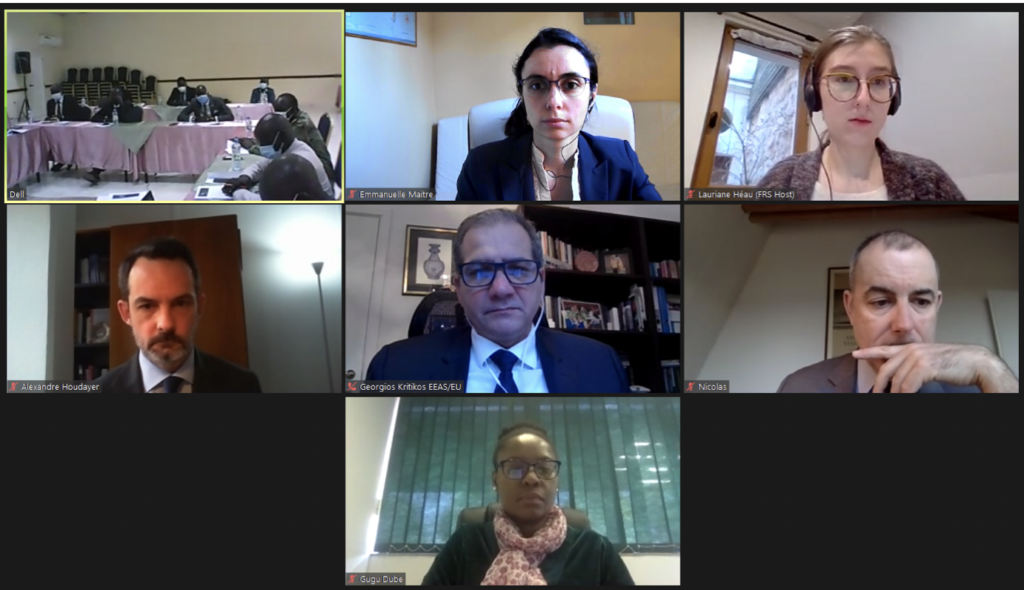
On 4 March 2021, the FRS and representatives from the government of South Sudan discussed over ballistic missile proliferation and the role of the Hague Code of Conduct. This event took the form of a hybrid event with representatives of South Sudan gathering in Juba and experts from FRS, the EU, the Swiss Chair, Austria and the ISS-Africa presenting virtually.
This mission was part of a series of targeted national visits.
AGENDA
INTRODUCTION & WELCOMING REMARKS
-
John CHIEK BUM KLZIER, Director for Security Research, Analysis and Policy Formulation, Bureau for Community Security and Small Arms Control, South Sudan
-
Alexandre HOUDAYER, Secretary General, FRS
-
Georgios KRITIKOS, Deputy Head of Division, Disarmament, Non-proliferation and Arms Export Control, EEAS, EU
-
Lt. Gen. Andrew KUOL NYUON GEW, Chairperson of the Bureau for Community Security and Small Arms Control, South Sudan
I/ The HCoC: A MULTILATERAL INSTRUMENT TO CURB THE PROLIFERATION OF MISSILES
PRESENTERS:
-
Nicolas PLATTNER, Head Arms Control, Disarmament and Non-Proliferation,Federal Department of Foreign Affairs, Switzerland – on behalf of the HCoCChairmanship
- George-Wilhelm GALLHOFER, Minister, Representative of the HCoC Immediate Central Contact, Ministry of Foreign Affairs, Austria
II/ INSERTING THE CODE INTO REGIONAL NON-PROLIFERATION & DISARMAMENT PRIORITIES
PRESENTERS:
-
Emmanuelle MAITRE, Research Fellow, FRS
-
Lauriane HEAU, European Projects Manager, FRS
-
Gugu DUBE, Research Fellow, Institute for Security Studies (ISS Africa)