
Expert's panel on hypersonic missiles at the HCoC Annual Regular Meeting

28 May 2026

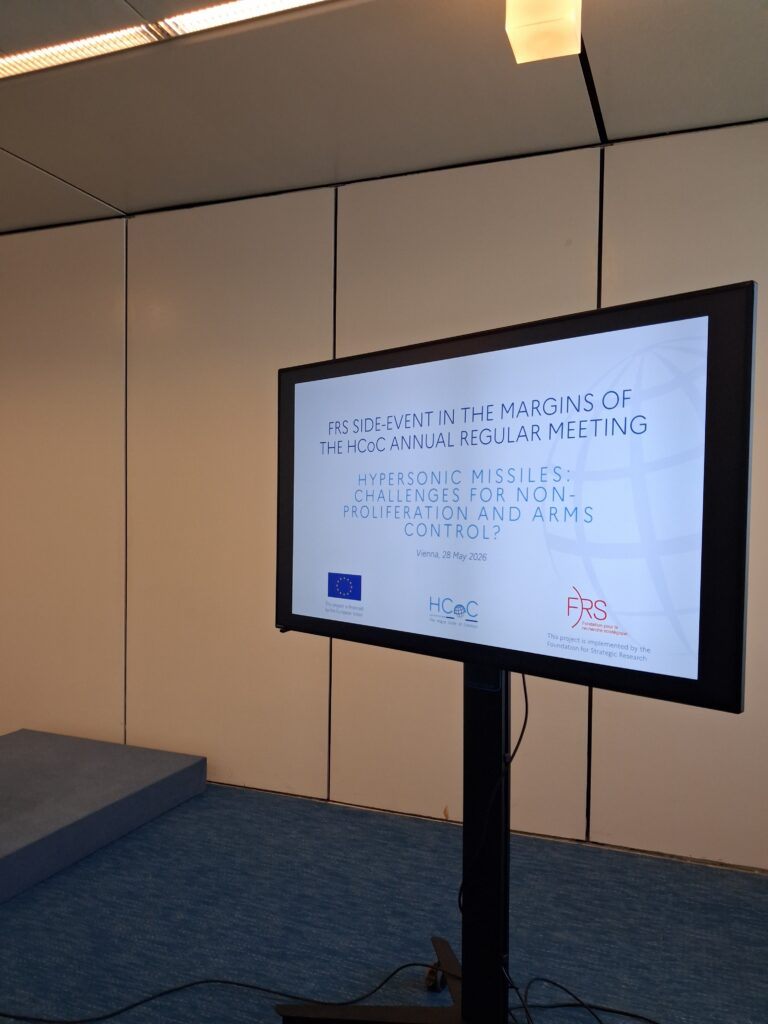
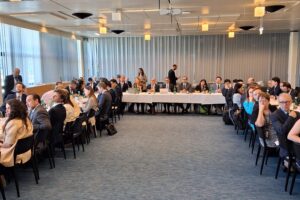
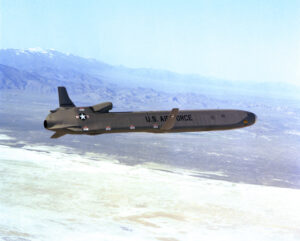
On 28 May 2026, the FRS organised a lunchtime side event in the margins of the HCoC Annnual Regular Meeting (ARM) in Vienna. This workshop focused on hypersonic missiles, trying to understand their specificities and how they can be integrated in the non-proliferation and arms control architecture.

AGENDA


WELCOMING REMARKS

  • Ms Markéta Homolková, Deputy Head of Division, Disarmament, Non-Proliferation and Arms Export Control, European External Action Service (EEAS), European Union


  • Amb. Alejandro Garofali Acosta, Ambassador and Permanent Representative of Uruguay to the International Organisations in Vienna, HCoC Chair 2025-2026


  • Amb. Mohammed Hindawi, Ambassador and Permanent Representative of Jordan to the International Organisations in Vienna, HCoC Chair 2026-2027

I/ THE ROLE OF THE HCoC DEALING WITH THE CURRENT BALLISTIC MISSILE LANDSCAPE

PRESENTERS: 

  • Dr Magnus Evestedt, Deputy Research Director, FOI

  • Ms Zuzanna Gwadera, Research Analyst and Programme Administrator, IISS

  • Ms Emmanuelle Maitre, Senior Research Fellow, FRS

  • Mr Kolja Brockmann, Senior Researcher (non-resident), SIPRI

Moderation: Alexandre Houdayer, Secretary General, FRS

Other publications

The Hague Code of Conduct Against Ballistic Missile Proliferation: “Lessons Learned” for the European Union Draft Code of Conduct for Outer Space Activities

Concerns about the harm caused upon orbiting space objects – whether intentional or accidental – have increased in recent years, as well as the emerging awareness that the security and safety of national satellites – of vital importance for modern societies but at the same time so vulnerable – relies on a collective effort. In December 2008 the EU responded to these concerns by adopting a Draft Code of Conduct (EU Draft CoC) for outer space activities.

Read More »
Other publications

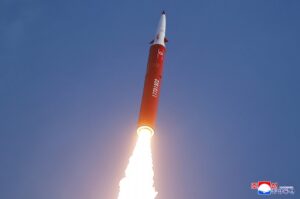
North Korean Short Range Systems: Military consequences of the development of the KN-23, KN-24 and KN-25

This study focuses on the new systems introduced, and assesses their potential impact as conventional weapons and as non-conventional weapons. Through an analysis of the possible capacities of these systems, this study examines their consequences on North Korean strategy. It concludes by exploring what this change of strategy may lead to, in military terms, and in political terms, on the Korean peninsula.

Read More »
Issue Briefs

The HCoC and Southeast Asian States

Only three out of ten Southeast Asian states have joined the HCoC to date (the Philippines, Cambodia and Singapore). This limited rate is noteworthy as Southeast Asia is increasingly concerned by the ongoing ballistic missile competition in broader Asia. Moreover, the region is actively investing to benefit from space technologies.

Read More »