Launches updates
Soyuz-5 Maiden Flight: Russia’s New Launch Vehicle Tested


30/04/2026
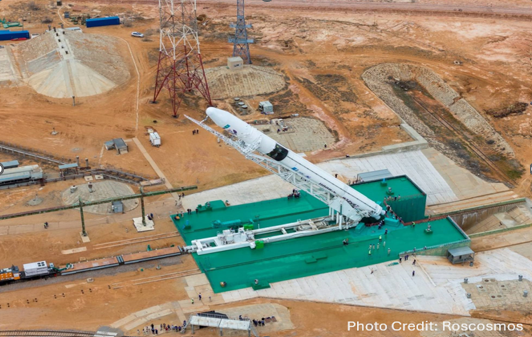
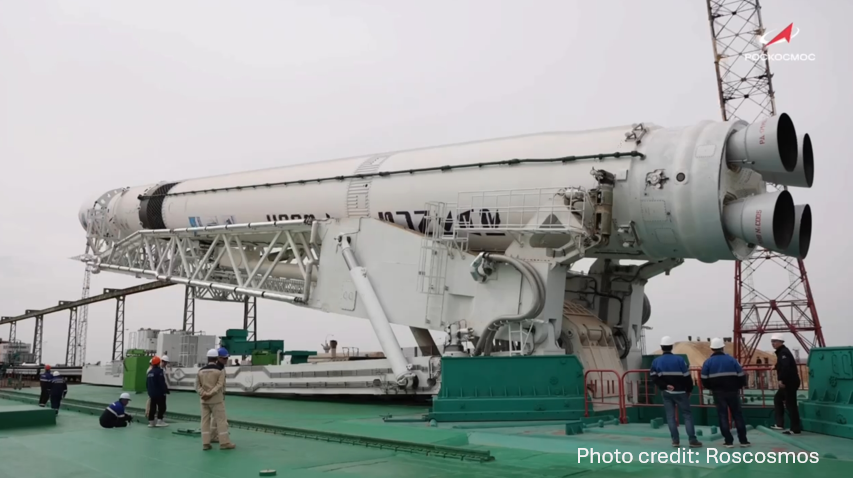
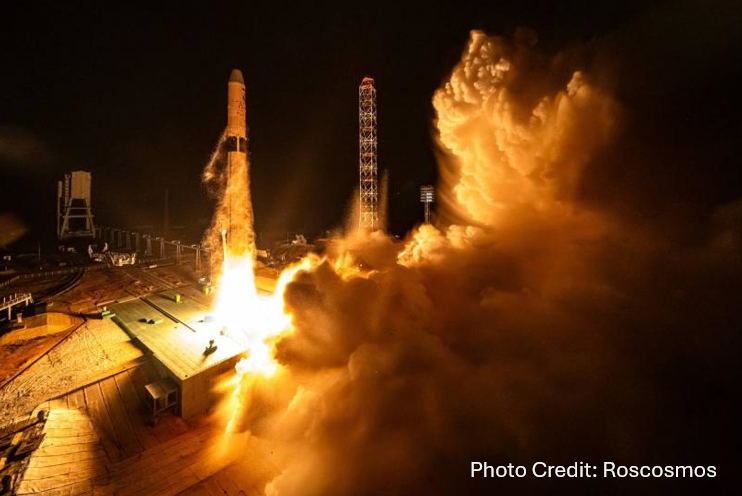
On 30 April 2026, Russia conducted the inaugural launch of the Soyuz-5 from Site 45 at the Baikonur Cosmodrome. Liftoff took place at 21:00 Moscow Time (20:00 UTC). The mission consisted of a suborbital test flight carrying a mass simulator, known as the Gabaritno-Massovy Maket (GMM), intended to validate the rocket’s performance under real flight conditions. 1
After liftoff, the vehicle initially followed a northward trajectory before turning east. The first stage, powered by the RD-171MV, operated for approximately 2 minutes and 59 seconds before separating at T+179 seconds.
The second stage, equipped with the RD-0124MS, ignited shortly before first-stage separation and initially operated through a lattice interstage structure. The fairing was fully jettisoned at approximately T+3 minutes and 5 seconds. During powered flight, the vehicle performed a maneuver to adjust its trajectory eastward and ensure a controlled reentry zone in the Pacific Ocean. The second-stage engine burned for about 6.5 minutes.
After engine cutoff, the vehicle entered a ballistic trajectory. A simulated separation between the second stage and the GMM payload took place at approximately T+572 seconds, near the trajectory’s apex. Both elements then reentered the atmosphere and impacted within a restricted area of the Pacific Ocean. According to Roscosmos, both stages operated nominally and the payload simulator reached the planned suborbital trajectory. The Soyuz-5 is designed to deliver up to 17-18 metric tons to low Earth orbit for uncrewed missions (around 15,500 kg for crewed configurations) and approximately 5,000 kg to geostationary transfer orbit. It is manufactured by the Progress Rocket Space Center.2
The Soyuz-5 is designed to fill the gap between Russia’s smaller Soyuz-2 rockets and the heavy-lift Angara A5, with a payload capacity placing it in the medium-lift class and a profile more oriented towards commercial missions, even if it can also serve institutional purposes. It is intended to replace the legacy Zenit launcher, whose last flight took place in December 2017 and restore an intermediate capability previously dependent on Ukrainian industry. The rocket is also expected to support future crewed missions with the Oryol spacecraft. Developed by Roscosmos (with RKK Energia as the prime contractor), it is the next-generation successor to Soyuz MS, designed for more autonomous operations and missions beyond low Earth orbit, including potential lunar trajectories.3 In this context, the development of the Soyuz-5 is part of a broader effort to maintain and renew Russia’s launch capabilities through a more cost-effective and commercially oriented launcher, aiming at filling the gap between existing light and heavy systems while ensuring independent access to space.4
Time | 30/04/2026, 8:00pm UTC |
Launch Vehicule | Soyuz-5 |
Launch site | Site 45, Baikonur Cosmodrome, Kazakhstan |
Stages | 2 to 3 stages |
Height | 65,26 m |
Launch Payload | LEO Orbit : 17 tons |
1 Mike Wall, Space.com, Russia’s new homegrown Soyuz 5 rocket aces debut launch, 1 May 2026, https://www.space.com/space-exploration/launches-spacecraft/russias-new-homegrown-soyuz-5-rocket-aces-debut-launch
2 NewSpaceEconomy, Russia’s Soyuz-5 Rocket Achieves Historic Maiden Flight: A Milestone for Roscosmos Amid Geopolitical Challenges, https://newspaceeconomy.ca/2026/05/04/russias-soyuz-5-rocket-achieves-historic-maiden-flight-a-milestone-for-roscosmos-amid-geopolitical-challenges/
3 Roberto Paradiso, SpaceVoyaging, New Russian PTK-Orel Pilotable Spacecraft Finally Shown, 23 October 2024 https://www.spacevoyaging.com/news/2024/10/23/new-russian-ptk-orel-pilotable-spacecraft-finally-shown/
4 Justin Mitchell, The Diplomat, The Soyuz-5 Will Transform Kazakhstan into a New Space Power, 30 April 2026 https://thediplomat.com/2026/04/the-soyuz-5-will-transform-kazakhstan-into-a-new-space-power/