Launches updates
First use of the Precision Strike Missile (PrSM) against Iran
March 2026
On 13 March, US Army General Dan Caine provided a video update on operation Epic Fury. He announced that the US Army and the US Marines had destroyed deposits, sunk ships and a submarine with ATACMS and hit deeply in Iran with the Precision Strike Missile (PrSMs) (3’34’’).1 He said that the unit who employed for the first time in combat the PrSM is the 3rd Battalion of the 27th Field Artillery Regiment (US Army) based in Fort Bragg, North Carolina and currently equipped with Himars.2 Announcement of the use of the PrSM for the first time for strikes had appeared at the beginning of the war.3 However, examination of available images, published by US CENTCOM (Central Command) or by observers in the Gulf, does not allow for visual confirmation of this debut at this stage. While it is highly likely that the missile was used, the location of its launch and the outcome of the strike are missing to confirm this first combat use.
Specifications
The PrSM is a surface-to-surface missile whose development began in 2016. The Army aimed to acquiring a 430 mm diameter missile with the ability to engage targets exceeding the ATACMS’ range. Its range was initially limited by the Intermediate-Range Nuclear Forces Treaty (INF treaty) who prohibited ground launched missiles with a range of 500-5,500 km. However, on 1 February 2019 Donald Trump suspended the US participation to the INF treaty. The PrSM may therefore have an extended range. The constructor, Lockheed Martin currently presents it with a range of “499+ km”.4 The increment 2 version that will give a maritime and a capability to engage moving targets has just been tested5 and future increments should reach a range beyond 1.000 km.6 Lockheed aims at a production of 400 missiles per year.7
Two platforms can carry and launch the PrSM:
- The Himars (High Mobility Artillery Rocket System), a 16-ton 6×6 truck.
- The M270 MLRS (Multiple Launch Rocket System), a tracked armoured vehicle that shares its chassis with the M2 Bradley. Heavier (24 tons) than the Himars, it cannot be carried by the aircraft C-130 Hercules.
These two vehicles were originally designed as multiple rocket launchers. Each carries a pod (two in the case of the M270) containing 2×3 rockets or one ATACMS. The rockets are 227 mm in diameter and have a range and payload that vary according to the model (up to 150 km range for the ER GMLRS). The ATACMS (Army Tactical Missile System) is a 610 mm missile with a range of up to approximately 300 km. PrSMs are missiles placed in pairs, side by side in standardised pods. Both platform (Himars and MLRS) can carry this missile.8
Time | March 2026 |
Category | Short-range Ballistic missile |
Launch Vehicule | PrSM |
Company | Lockheed Martin |
Range | 499km+ |
Launch site | Gulf region |
Author: Michel Camelot
First Look
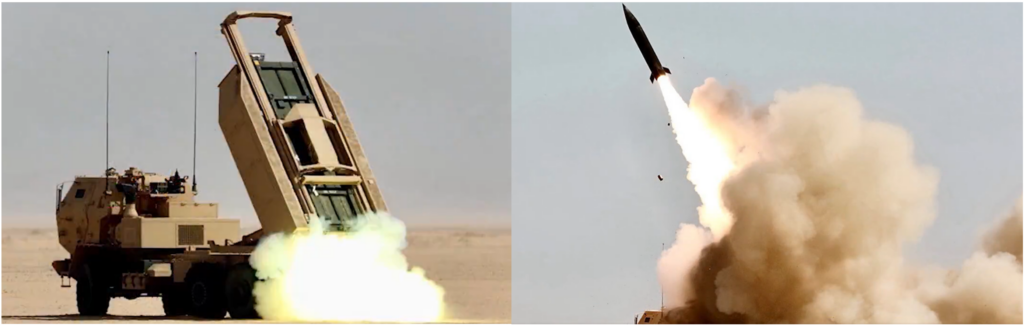
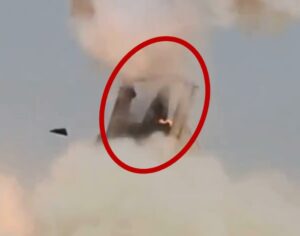
In a slideshow published on X on 1 March 2026, US CENTCOM (Central Command) gave information about the first 24 hours of operation Epic Fury.9 At the eighth second, appears a picture of a M142 Himars. Interestingly, this launcher is equipped with an unknown pod that seems separated in two canisters. The pod with a double launch tube is intended for the PrSM. Just after this picture, the slideshow displays a launch of a missile, right above the truck, which appears to be neither a traditional rocket nor an ATACMS because its diameter or shape seems to differ.
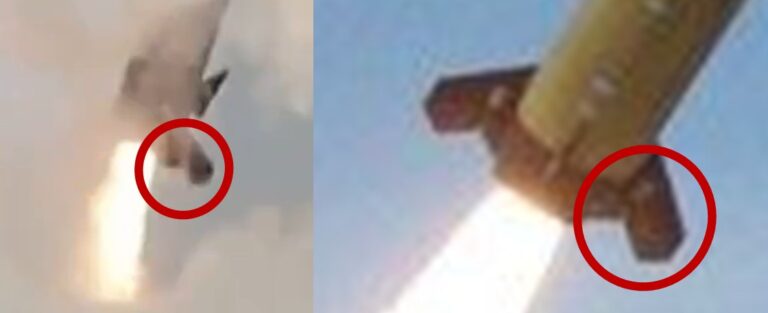
An analysis of the missile’s shape, particularly its tail section, appears to indicate that the United States indeed used a new type of missile in combat. The shape of the fins and the missile in the second image appears to match those of the PrSM, of which few photos have been published as the missile is new and its future versions are still under development, rather than those of the ATACMS.
Therefore, the questions arises as to whether these images come from the current operations against Iran or whether CENTCOM press services used other images of Himars for the video. Several signs could primarily help us to respond. Firstly the armoured vehicle is in a desert, secondly its livery is sand and thirdly the pod is green as if it had been recently deployed. Therefore, it seems that the first PrSM deployment in combat is ongoing. The two pictures inserted in the slideshow seem to have been chosen thoroughly. The back of the pod is masked by the rocket smoke. This part normally enables to distinguish the type of ammunition used when the vehicle is photographed while driving.
Confirmation
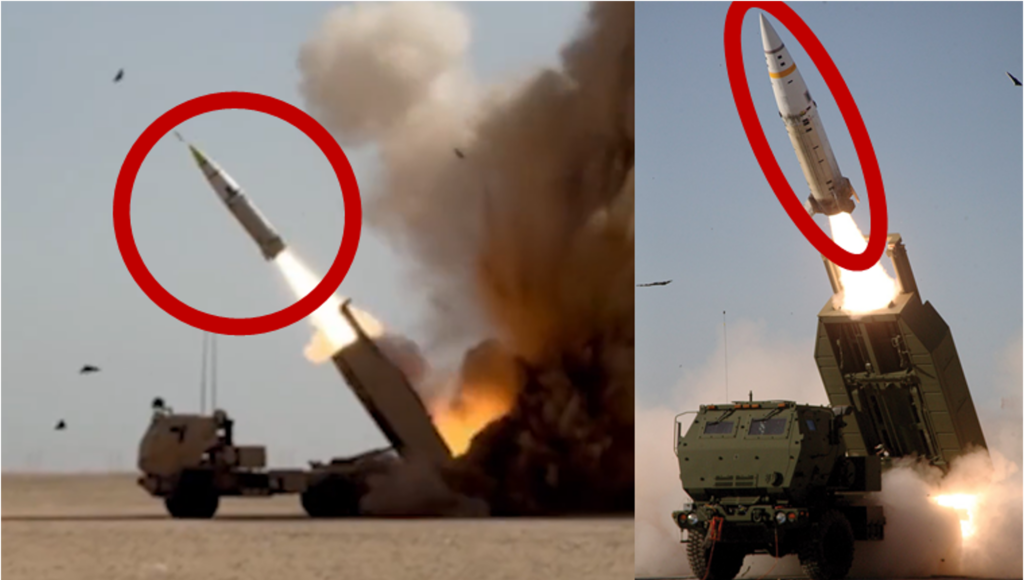
On 4 March, on X, US CENTCOM reuses the second picture in a public briefing (4’03’’) and announced that the US Army soldiers are used to carry out surface to surface strikes.10 The speaker affirms that the US Army employed, for the first time in combat, the PrSM, which offers ‘an unrivalled deep strike capability.’ In addition to the photo of the missile taking off, several video clips are used to illustrate the point. However, it appears that none of the missiles in these videos are PRSMs. On the contrary, it seems that US CENTCOM inserted footage of ATACMS launches to illustrate what a PRSM launch would look like.
Several features can be observed, such as:
- The dimensions of the vector (which appears much wider compared to a PrSM).
- The shape of these fins (which is the same as that of an ATACMS).
- The vector’s central position is that of an ATACMS (The PrSM would be positioned more to one side, because there are two per pod).
On 4 March 2026, on X, right after the briefing video, US CENTCOM published another video in which CENTCOM Command adds that ‘[he] just could not be prouder of our men and women in uniform leveraging innovation to create dilemmas for the enemy.’11 No footage used in this video shows a PrSM; the two previous photos are not even reused. The video clips shown during the briefing are being replayed, and additional clips are being added. In one of them, the missile’s colour is clearly visible and matches that of an ATACMS.
Operational analysis
The US Army’s claim of having used the PrSM for the first use in combat during this war is credible. But we only have two pictures of this possible launch and nothing can prove its time and its position. The PrSM has entered service roughly two years ago, and stocks could have reached 80 missiles by the end of 2025.12 Therefore several PrSM could have possibly been used against Iran. However, no battle damage assessment (BDA) has been made public and the rare footages of Himars strikes during this war seem to illustrate ATACMS launches.13 We have no way of assessing the missile’s reliability, accuracy, or range. Its launch and flight profile also remain unknown. We can notice that the platform used to launch PrSM is the M142 Himars. The logistics footprint of this type of armoured vehicle is far from being a detail when such a great operation away from the homeland. Therefore the absence of available videos of the M270 is logical, as they are much heavier and harder to carry and deploy rapidly.
Geolocation of the launches is impossible at this stage with US CENTCOM’s footages’ but some launches14 or convoys15 of Himars have been observed in Bahrein by observers and posted on social networks. Qatar, Kuwait and the United Arab Emirates (especially against naval targets) are other possible locations of launches.
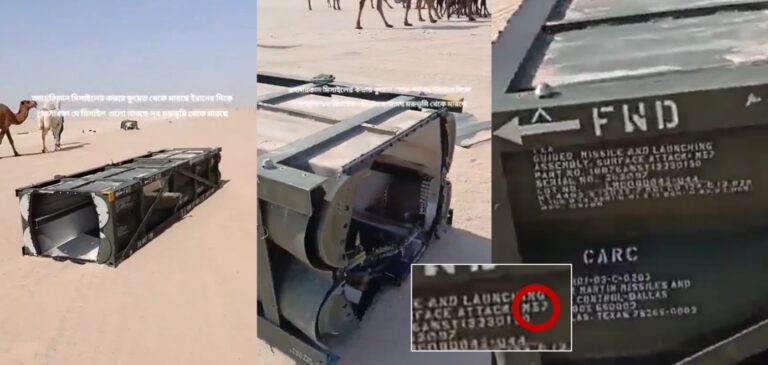
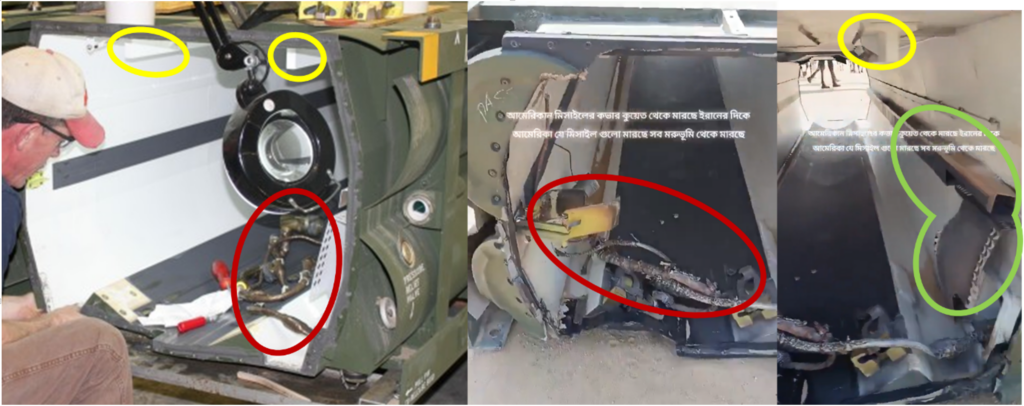
We should also note that U.S. Army employed deception during ‘Epic Fury’ by camouflaging ATACMS in a pod modified to look like a six rocket-pod. An unofficial video showing two such pods abandoned in the desert was posted on X on 9 February 2026. It is clearly written “M57” on it, the latest version of the ATACMS.16
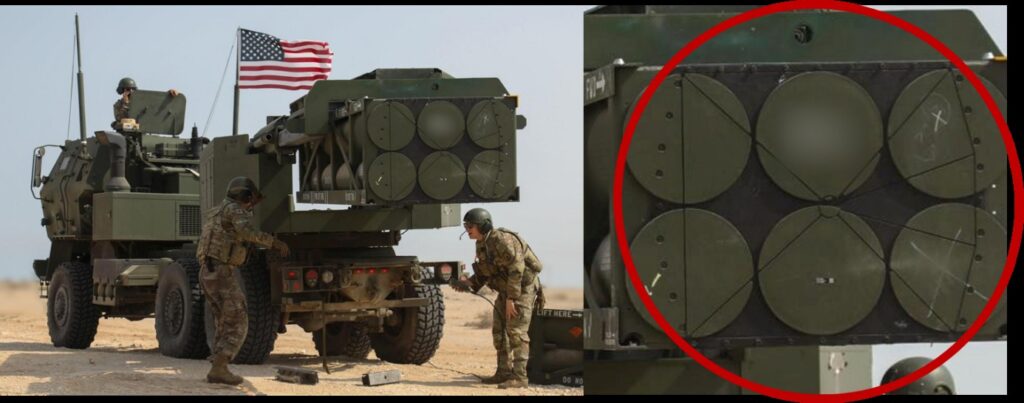
That same day, US CENTCOM posted a picture of this kind of pod being loaded on Himars. While the canister is configured to launch the ATACMS, its hatch voluntarily gives the impression that it carries six rockets.
It appears that this pod, the M39MLPC, has been in use since the Gulf War to mislead the enemy about the capabilities of the deployed vectors. It is possible that the PrSM, too, will eventually be equipped with a standard pod similar to the M39 MLPC, in which the two canisters would be concealed within six rocket-shaped casings.
In sum
In sum, the Iran war is certainly the first theatre where the PrSM is being deployed. It is also very probably the first use of the system in operation, after campaigns of tests in the United States and Australia. From an arms control point of view, the first use of PrSM by the United States, in parallel to the use of Oreshnik in Ukraine, symbolised the end of the attempts to regulate medium and intermediate range systems and their recognition by armed forces as conventional weapons potentially useful on the theatre.
1 DOW Rapid Response, X, 13 March 2026, https://x.com/DOWResponse/status/2032438073603072217
2 3rd Battalion 27th Field Artillery Regiment, 20 September 2024, https://www.facebook.com/share/p/1D91FnbeDT/
3 Joseph Trevithick, ‘America’s New PrSM Ballistic Missile Just Made Its Combat Debut,’ The War Zone, 1 March 2026, https://www.twz.com/land/americas-new-prsm-ballistic-missile-just-made-its-combat-debut-in-iran-strikes
4 Lockheed Martin, ‘Precision Strike Missile (PrSM),’ 13 March 2026, https://www.lockheedmartin.com/en-us/products/precision-strike-missile.html.
5 Lockheed Martin, ‘ PrSM Increment 2 Takes Flight and Advances Army’s Moving-Target and Maritime Capability,’ 13 March 2026, https://news.lockheedmartin.com/2026-03-12-PrSM-Increment-2-Takes-Flight-and-Advances-Army-s-Moving-Target-and-maritime-capability
6 Lockheed Martin, ‘Scaling Precision: How Lockheed Martin is Building the Arsenal for the Army’s Next-Generation Strike Missile,’ 13 March 2026, https://www.lockheedmartin.com/en-us/news/features/2025/scaling-precision-how-lockheed-martin-is-building-the-arsenal-for-the-armys-next-generation-strike-missile.html
7 Jen Judson, ‘Army accelerates PrSM output as ATACMS nears sunset,’ Defense News, 13 October 2025, https://www.defensenews.com/land/2025/10/13/army-accelerates-prsm-output-as-atacms-nears-sunset/ 03/13/2026.
8 Lockheed Martin, ‘Precision Strike Missile (PrSM),’ 13 March 2026, https://www.lockheedmartin.com/en-us/products/precision-strike-missile.html
9 US CENTCOM, X, 1 March 2026, https://x.com/CENTCOM/status/2027990979253334026?s=20
10 US CENTCOM, X, 4 March 2026, https://x.com/CENTCOM/status/2028983418801803741?s=20
11 U.S. CENTCOM, X, 4 March 2026, https://x.com/CENTCOM/status/2029219939102401017?s=20
12 Jen Judson, op. cit.
13 U.S. CENTCOM, X, 1 March 2026, https://x.com/CENTCOM/status/2027919256709423376?s=20
14 Mossad Commentary, X, 7 March 2026, https://x.com/MOSSADil/status/2030350596444995969?s=20
15 John Marquee, X, 3 March 2026, https://x.com/john_marquee/status/2028626017804497182?s=20
16 Strategic Lens, X, 9 March 2026, https://x.com/StrategicLensHQ/status/2031012013858808153?s=20