Launches updates
India Confirms New Test of MIRV-Capable Agni-V Missile


8 May 2026
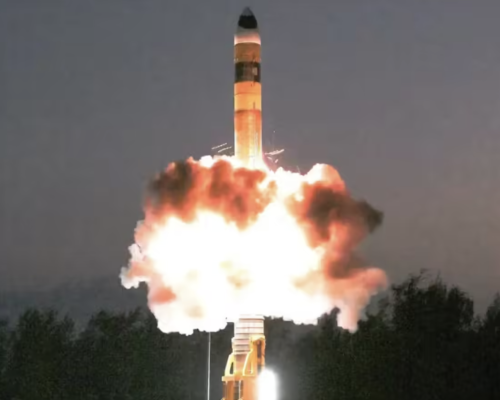
India’s ministry of Defence confirmed on May 10 that the country had successfully conducted a flight test of an advanced Agni missile with Multiple Independently Targetable Re-entry Vehicle (MIRV) capability from Dr APJ Abdul Kalam Island off the Odisha coast on May 8. MIRV technology allows a single ballistic missile to carry and deploy multiple nuclear warheads toward different targets while improving its ability to evade missile defence systems. According to the ministry, the missile was tested with multiple payloads aimed at targets distributed across a large geographical area in the Indian Ocean Region, and flight data confirmed that all mission objectives were met.1
The missile tested was reportedly an advanced MIRV-capable iteration of the Agni-V. Also referred to as “Mission Divyastra,” this launch marked the second known test after an earlier launch in March 2024. The nuclear-capable Agni-5 has an officially declared strike range of more than 5,000 kilometres, placing targets deep in Asia, including China, as well as parts of Europe and Africa within reach. The Agni missile family consists of solid-propelled ballistic missiles ranging from short-range systems to intercontinental ballistic missiles.
At the regional level, several countries have developed or tested MIRV-capable ballistic missiles. China has deployed the DF-5B and DF-41 intercontinental ballistic missiles with confirmed MIRV capability, while North Korea has tested the Hwasong-15 and Hwasong-18 ICBMs, reportedly with multiple warhead potential, although technical details remain limited. In North Korea’s case, MIRV ambitions remain largely aspirational, though technical cooperation with Russia could support future development.2
With regard to Pakistan, the Ababeel is described as the country’s most advanced ballistic systems, but its technological maturity remains uncertain. The Ababeel is officially presented as MIRV-capable, intended to penetrate missile defenses and strengthen medium-range deterrence.3
MIRV technology in the region, pursued by India, Pakistan, and North Korea, serves both political prestige and strategic objectives: it enhances second-strike potential, complicates adversaries’ defense planning, and reinforces nuclear deterrence credibility. In India, MIRV-equipped Agni-V missiles provide a credible threat to multiple Chinese targets, while Pakistan’s Ababeel aims to maintain regional deterrence parity.4
Time | 8/05/2026 |
Category | ICBM |
Launch Vehicule | Agni V ? |
Company | DRDO |
Range | 5000 km |
Technology | MIRV |
1 Surendra Singh, Test of advanced Agni missile with multiple warheads technology a success, 10 May 2026,
http://timesofindia.indiatimes.com/articleshow/130982862.cms?utm_source=contentofinterest&utm_medium=text&utm_campaign=cppst
2 Brendan Thomas Noone, Asia’s escalating missile race, 25 January 2018, https://www.lowyinstitute.org/the-interpreter/asia-s-escalating-missile-race
3 Antoine Levesques, Pakistan missile test confirms its MIRV ambitions, 7 November 2023, https://www.iiss.org/online-analysis/missile-dialogue-initiative/2023/10/pakistan-missile-test-confirms-its-mirv-ambitions/
4 Emmanuelle Maitre, Bulletin n°120, Observatoire de la dissuasion, FRS, May 2024, https://www.frstrategie.org/web/documents/programmes/observatoire-de-la-dissuasion/bulletins/2024/120.pdf